
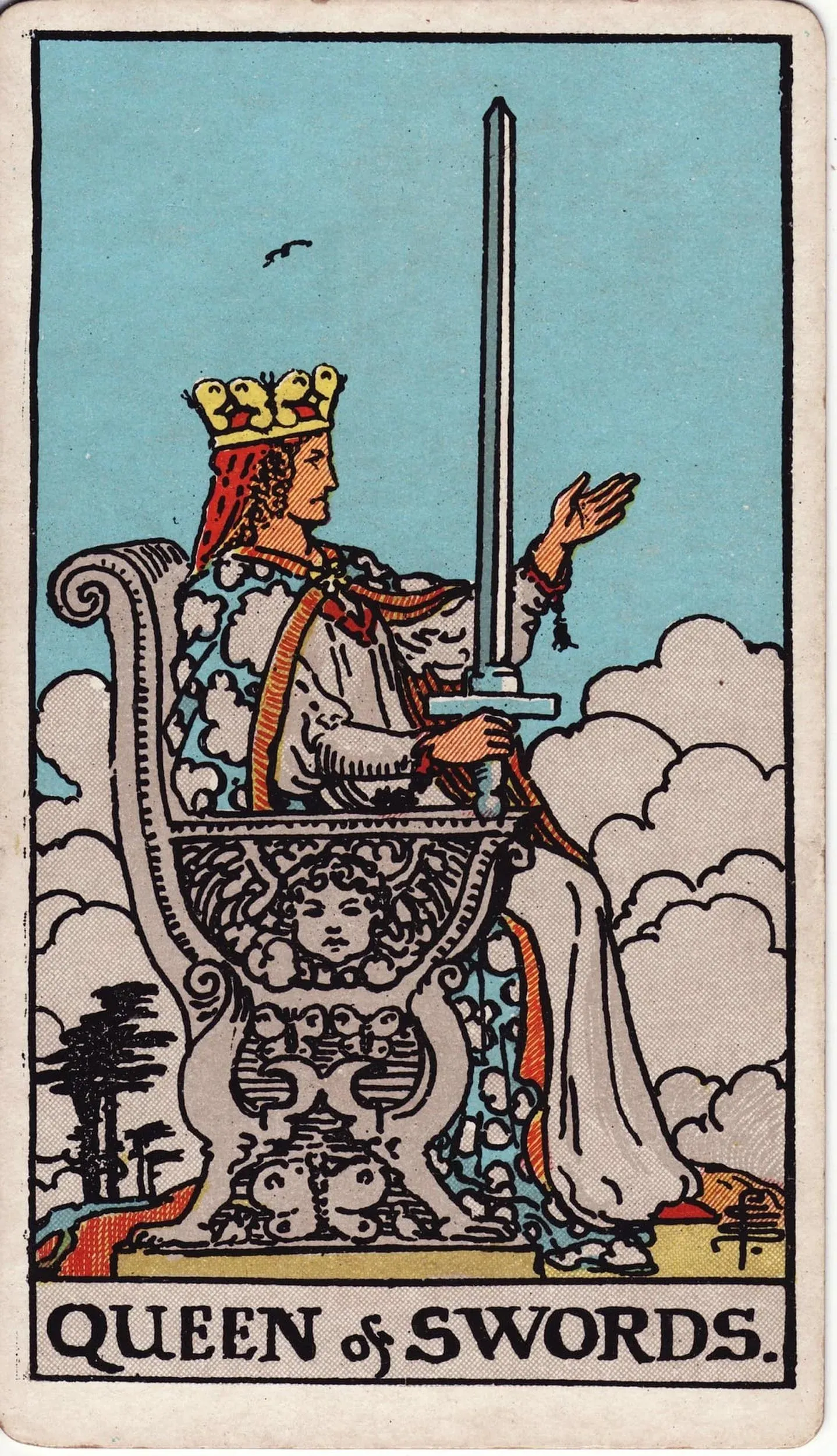
A queen sits with her sword held straight up in her right hand and her left hand open. Birds and butterflies are carved into the stone of her throne. She looks ahead and slightly up, past the person in front of her. In a reading she stands for judgement that has been tested, the clear sight a person earns rather than inherits.
What the Queen of Swords says upright
Upright, she is the friend who tells you what she actually thinks. Her strength is discrimination: she can separate a real problem from a story about one, and she would rather hear the awkward fact than a comfortable version of it. Expect straight answers, and expect her to ask for the same in return.
Alongside the directness there is independence. She does not need agreement to feel secure in her position, and she is not easily pushed by other people’s expectations. When this card comes up, it often suggests a decision that has to be made on your own terms, without waiting for anyone’s blessing.
She can point at a person rather than a quality: a woman in the querent’s life who is sharp, fair, a little intimidating, and gives advice without softening it.
What the Queen of Swords says reversed
Reversed, the clarity curdles. The same sharp eye becomes a habit of criticism, and honesty slides into sarcasm or a remark designed to land. It can describe someone in your life who uses cleverness to keep the upper hand, and it can describe you on a bad day.
There is a quieter reversed reading too. Cut off from her own feelings, she can be lonely without admitting it, or so used to coping alone that she will not let anyone close. Occasionally the card appears for the person who stays silent and swallows the sharp truth instead of saying it.
Questions to ask in a reading
- What are you not saying, and what does the silence cost you?
- Are you being honest, or are you being harsh and calling it honesty?
- Which boundary have you been meaning to draw?
- Who in your life does this card bring to mind?
How it reads with the other cards
With Justice, the two cards weigh the same evidence and leave sentiment out of it, which makes a fair outcome more likely than a kind one. Beside the Three of Swords the queen’s sharpness has grief underneath it, and the words that hurt were said from a real wound. When the King of Swords joins her, the reading turns to two clear minds in the same room, agreeing or arguing.