
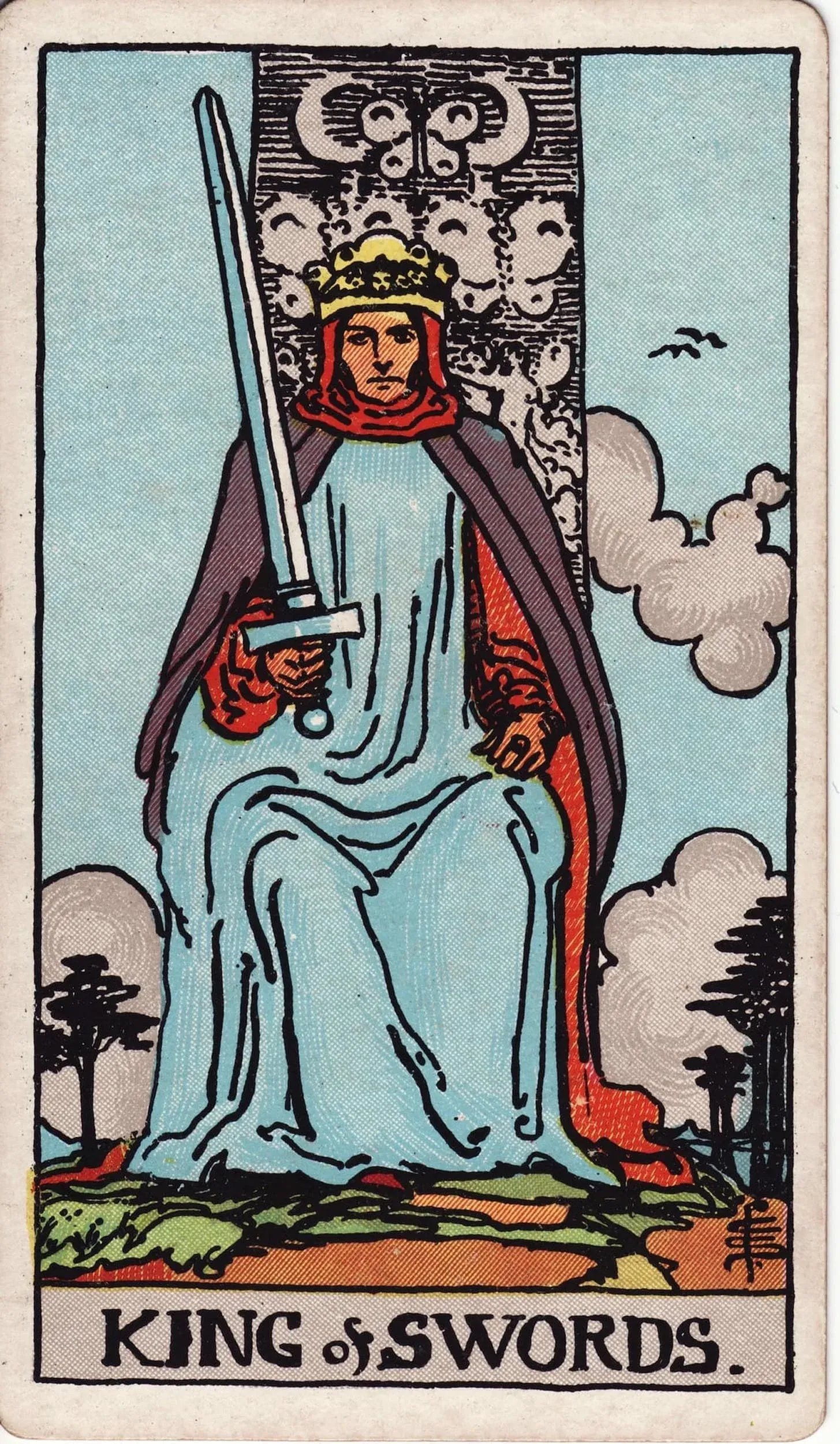
The King of Swords sits on a grey stone throne with his sword held upright, the blade level with his eyes. Butterflies are carved into the throne, a bird sits above them, and clouds drift behind him. His gaze is level and his expression gives nothing away, which suits the card: this is the part of a reading that wants facts before feelings. He turns up when a decision needs making clearly, or when someone in the situation is speaking with real authority.
What the King of Swords says upright
Upright, he is fair, precise and difficult to rush. He stands for the person who reads the contract, asks the awkward question and gives an answer that still holds up a month later. In a reading he can be the querent on a clear-headed day, or someone with authority over them: a manager, a doctor, a lawyer.
His advice is to work from the facts and then commit. Gather what you actually know, weigh it honestly, and say what you think in plain language. He is also the card of integrity, since an argument only holds if you are being straight about it, and half-truths tend to find their way back to him.
What the King of Swords says reversed
Reversed, the same intelligence is being used badly. That can be someone in authority who is twisting the facts or passing off self-interest as policy, and in a reading about work or family it is worth asking who benefits from the version of events you have been handed.
The reversal can point inward as well. Your own thinking has gone rigid, or you are using an argument as a weapon because being right has become the point. Swinging between decisions is another form of it. He asks for honesty about your motives, and for the willingness to say you do not know.
Questions to ask in a reading
- What do I actually know here, and what have I only been told?
- Whose version of events am I relying on, and what do they gain from it?
- Am I arguing to find an answer or to win?
- Where do I need to be fair, including to someone I dislike?
How it reads with the other cards
With the Queen of Swords he describes a household or workplace where people say exactly what they mean, which is useful and occasionally cold. Next to the Emperor the authority is formal and structural, and beside the Two of Swords the same intelligence has stalled and cannot decide.