
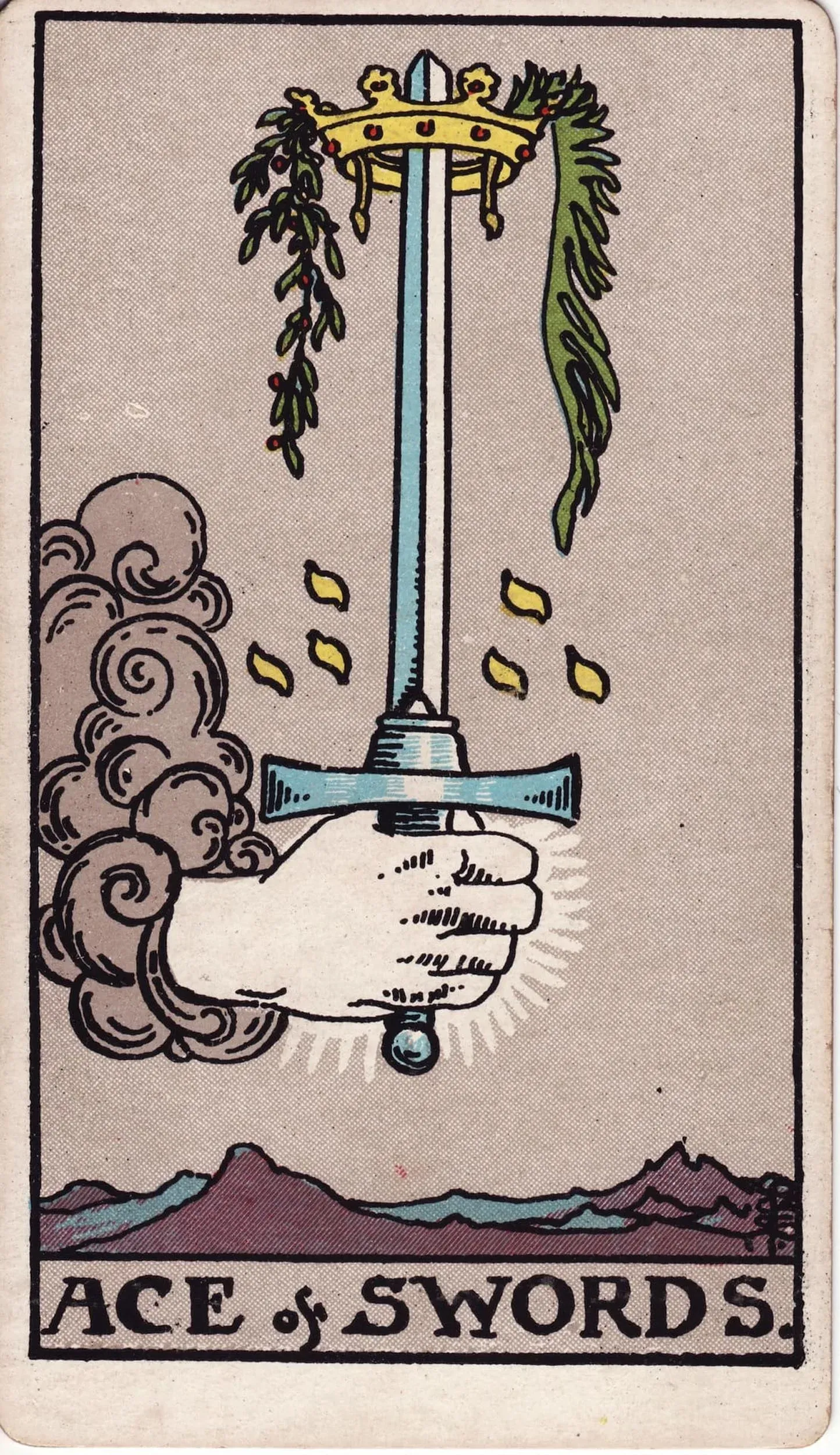
The Ace of Swords shows a hand coming out of a cloud, gripping a sword that points straight up. A crown sits on the tip of the blade and a wreath hangs from it. In a reading it marks the moment something becomes clear, often suddenly. A conversation, or a decision that has been avoided for months, cuts through confusion that had been sitting there for weeks.
What the Ace of Swords says upright
Upright, it is about seeing a situation as it is. Ideas arrive quickly, and you may find you can explain something you have been circling for months. It often turns up when a decision can no longer be postponed, or when someone finally says the thing out loud.
The sword is a tool for cutting, and the card usually asks what needs cutting. Old excuses, or a plan that only ever worked on paper. Clarity of this kind is useful even when it is uncomfortable, and it tends to arrive before you feel ready for it. Words also carry further than people expect when the thinking is this sharp, so the card is worth handling with care.
What the Ace of Swords says reversed
Reversed, the Ace of Swords points to fog rather than insight. Thoughts go round in circles, an argument misses the point, or a message is read the wrong way. Sometimes it shows up when somebody is talking a great deal without saying anything true. Before replying to anything, it is worth checking what was actually meant.
It can also mean the idea is there but not yet sharp enough to act on. In that case the card suggests slowing down and asking a direct question before deciding anything.
Questions to ask in a reading
- What am I finally able to see clearly?
- Where am I avoiding a conversation because it would change things?
- Is this idea ready to act on, or does it need another week of thought?
- What am I telling myself that is not quite true?
How it reads with the other cards
The Ace of Swords often sits beside the Magician, where a clear thought meets the skill to do something with it, or the Two of Swords, where clarity has not arrived and a choice is still being avoided. With Justice it points to a decision that has to be made honestly, whatever the answer turns out to be.
Ace of Swords as feelings
In a feelings reading, the Ace of Swords can describe a moment of recognition: you suddenly understand what you want, or you can finally put a complicated feeling into words. Someone else may be ready for an honest conversation after a period of mixed signals. The card is more about clarity than warmth, so do not mistake a direct answer for a full account of affection.
If you asked about another person, look at what they actually say and do. They may be attracted to your mind, want to clear up a misunderstanding or need to make a decision. The sword can cut through confusion, but it can also make a person sound sharper than they mean to. Ask for the substance beneath their phrasing.
Reversed, the feeling may be real while the words are not yet ready. You might be rehearsing a conversation in your head and coming out of it angry before it has happened. Slow down enough to distinguish what you know from what you fear. The card cannot read a private mind; it can point you toward the question worth asking aloud.
Ace of Swords in love and relationships
For a relationship, this Ace often arrives when something needs to be named. Perhaps a boundary has been crossed, a promise is unclear or both people have been using the same word to mean different things. The card favours a plain conversation over another week of interpreting hints. Start with what happened and how it affected you, then leave space for the other person’s account.
When a connection is new, the Ace can show the excitement of meeting someone whose ideas engage you. Talking may come easily, but a quick intellectual bond is only one part of closeness. Notice whether difficult feelings can be discussed without turning into a debate someone has to win.
Reversed, words can become weapons or disappear altogether. A message written at midnight may sound certain and still leave the real issue untouched. If a conversation keeps circling, agree on one question at a time. Clarity is not the same as bluntness: the best use of this sword is to make room for truth that both people can bear to hear.
Ace of Swords yes or no
The Ace of Swords leans yes when the next step is to ask, speak, write, investigate or decide. It is the card of a clear beginning, and the answer may arrive through a conversation rather than through waiting for a sign. If your question concerns signing an agreement, the yes depends on understanding every term before you do.
For a question about whether someone is telling the truth, this card advises verification rather than delivering a verdict. Request the information you need and compare it with what you already know. Reversed, pause: important facts may be missing, or you may be too close to the dispute to see them clearly. A yes or no reading should make your next action more precise, not pretend to replace evidence.
Ace of Swords reversed: what to do about it
Write the situation in three columns: what happened, what you infer and what you still need to ask. This small exercise can show where a strong feeling has been mistaken for a fact. If you are facing a difficult conversation, draft one opening sentence that describes your experience without assigning an intention to the other person.
Reversed clarity sometimes means overload. Too many opinions, messages or possible outcomes can make the obvious question hard to hear. Reduce the decision to what must be known now. You may need a document, a direct answer or a night’s sleep before you can choose. If you are angry, wait until you can say the important thing without trying to win the exchange.
The sword also asks you to notice when you are avoiding a truth because it will require action. Once you have enough information, more research may only delay the conversation. Set a point at which you will decide what to say or do.
Ace of Swords in career and money
At work, this Ace can be a useful idea, a decisive email, a contract or a new way to define a problem. It favours clear briefs and direct questions. Before you start a project, ask what success means and who has the final say. A sharp idea loses force when the people involved are working from different assumptions.
If money is involved, read the terms. The Ace can signal a negotiation or a chance to see through vague promises, but it does not guarantee a favourable result. Get a figure, a date and a written scope. If you are considering a career change, distinguish what is wrong with the current role from what the new one actually offers.
Reversed, miscommunication can be expensive. Check the version of the proposal everyone is using, correct an error promptly and avoid sending a difficult message in haste. The practical gift of this card is a cleaner sentence: what, exactly, needs to be understood before the next step can happen?