
Tarot Spreads & Practice
Yes No Oracle Guide: Get Clear Answers Today
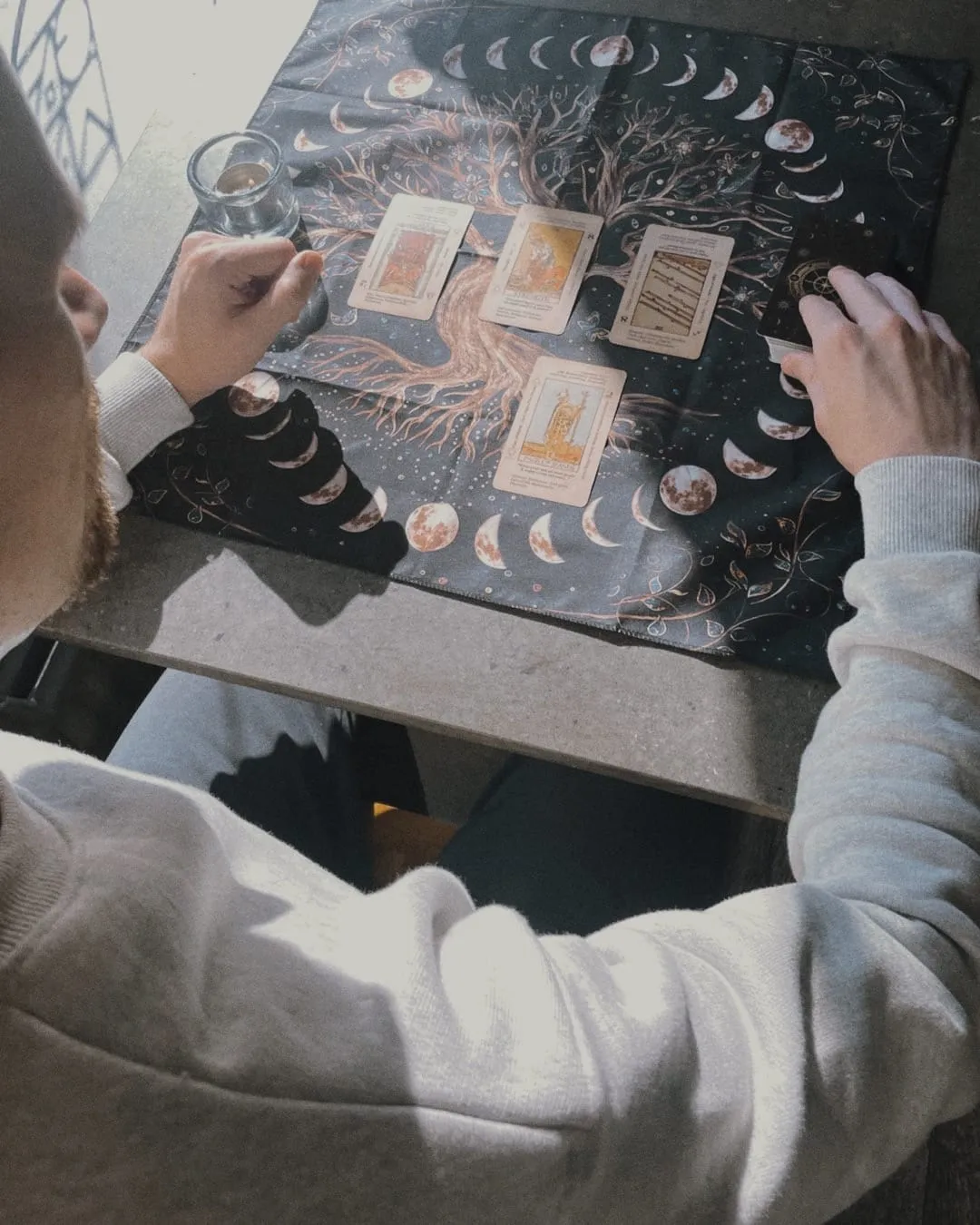
When you are stuck between two choices, a yes no oracle narrows the whole tangle down to one question and one answer. It will not decide anything for you and it does not see the future. What it does is strip away the what ifs and maybes for a moment, so you can look at the core of the decision.
The tool can be a pendulum, a coin, a card or an app. What matters is the question you bring and whether you can read your own reaction to the answer. You may find the answer arrives before the tool has stopped moving, and that first reaction is worth more than anything the object itself does.
What is a yes no oracle
A yes no oracle is any method you use to get a binary answer: yes or no, this way or that. Pendulums, coins, cards and apps all count, and none of them is doing the thinking. Asking a question with only two possible answers forces you past the surrounding noise. The answer usually reflects something you already sense but have not admitted, which is why it can be easier to trust than a long list of pros and cons.
This is why the practice depends on honesty. If you ask for a verdict while secretly wanting one outcome, you will get the verdict your hopes were pointing at, and you will probably know it as soon as it lands. Asking plainly, and being willing to hear either answer, is what makes the reading worth anything.
Take the pendulum. Its swing comes from small, unconscious movements in your hand and arm, and those follow your body’s response to the question. The pendulum shows you a gut feeling at a size you can see, which is easier to act on than a vague sense of unease. Nothing mystical needs to happen for it to be useful.
Think of the whole thing as a compass for your energy in this moment rather than a fortune teller. It shows you which direction you are already leaning, which is often enough to help you decide. The same principle sits behind tarot as a tool for self-reflection and not prediction.
That does mean the answer comes from you. It can feel odd at first if you came hoping for a sign, though a clearer view of your own leaning tends to be more useful than a sign would have been.
Common types of yes no oracles
Each tool has a different feel and they all deliver the same thing: a clear answer. For more involved questions you can also learn how to combine tarot and oracle cards in readings to get more layered insights.
| Oracle tool | How it works | Best for |
|---|---|---|
| Pendulum | A weighted crystal or object on a chain swings in a set direction, for example clockwise for yes and back and forth for no. | Tapping into subconscious energy and getting a physical, visible answer. |
| Coin | The classic toss, with yes assigned to heads and no to tails, or the other way round. | Quick decisions when you need an answer on the spot. |
| Oracle or tarot cards | A single card is drawn, and its meaning or orientation gives the answer. | Readers who already know the cards and want a simple yes or no from them. |
| Digital apps | A website or phone app returns a random yes or no at the press of a button. | An immediate answer when you have no physical tools with you. |
Pick whichever tool you will actually use. A pendulum asks for a steady hand and a few quiet minutes, a coin works anywhere, and an app is instant and silent. The method matters far less than the habit of asking a proper question.
Preparing for a clear reading
The quality of the answer depends on the state you are in when you ask. If you are anxious, or desperate for one particular outcome, that is what the tool will pick up. Getting calm first is most of the technique.
It also helps to arrive with a single question. A general cloud of worry gives you a general cloud of an answer. Sit down with one specific thing you want to know and the reading stays focused.
Making a quiet space
Find somewhere you will not be disturbed for a few minutes. This does not have to be a ritual. A comfortable chair, a closed office door or a step outside will do, as long as it signals that the time is set aside for one thing.
Turn off your notifications and take a few slow, deep breaths. If your home is noisy, headphones and a few minutes of quiet music do the same job. Breathing like that settles the body quickly and brings you into the present moment, which is where your intuition is. You want your mind to be a still pool, since a pendulum reads the ripples.
Setting up deliberately also tells you that you mean it. That matters more than candles or crystals, and it costs nothing.
Clearing your energy and your tool
If you use a pendulum, a deck or a crystal regularly, give it a quick clean between readings. Anything that has been sitting around picks up your ordinary mood, and a tool carrying yesterday’s worry is harder to read clearly.
Pass the object through incense smoke, leave it in moonlight overnight, or hold it in your hands and set a firm intention that it be cleared. A simple routine is to cup it in both hands, close your eyes, and ask that anything left over from earlier readings be released. Picture a bright white light around it if that helps. The whole thing takes under a minute and gives you a clean slate.
Asking the right kind of question
Nothing affects a yes no reading more than the question. Vague questions produce vague answers. If you ask something broad like “What about my career?”, the energy is spread thin and the oracle has nothing concrete to work with. A single sharp query that can only be answered yes or no is much easier to trust.
A good question is also one you can act on. Before you ask, check that either answer would tell you something useful. If a yes and a no would leave you in the same place, the question needs more work.
The exercise is useful on its own. To make a question binary you have to decide what you actually want to know, and that is often the hardest part of the decision.
From vague to precise
Turning a worry into a question means moving from open-ended to closed. A general question is like a radio dial full of static, while a precise one tunes into the station.
- “What should I do about my relationship?” becomes “Is ending this relationship the healthiest choice for me right now?”
- “Will I be successful?” becomes “Is launching my own business this year the right move for me?”
- “What is going on with my finances?” becomes “Should I accept the new job offer to improve my situation?”
The precise versions are all about your own actions and choices, which means they give you a clear path forward whatever the answer turns out to be. The vague versions ask the oracle to describe a situation for you, and that is not what it is built for.
Questions to avoid
A few habits cause most of the muddle.
The first is asking about other people. Your oracle reflects your own intuition, not someone else’s private life. “Does he still love me?” is not a question it can answer. “Am I staying in this relationship for the right reasons?” is.
The second is phrasing things negatively. “Should I not go to the event?” invites confusion, because the answer arrives wrapped in a negation. Frame it the other way round: “Is it in my interest to go to the event?”
The third is bundling several questions into one, like “Should I move to the city and change my job?” That is two decisions with different answers. Ask about the move first, then come back and ask about the job, and you get a clear signal for each part.
Your first reading, step by step
Once your mind is settled and your question is ready, you can start. A pendulum is the easiest tool to learn with because its movements are so easy to see.
Setting your yes and no signals
Before you ask anything real, teach the tool its two answers. Hold the pendulum by its chain and let it hang still, with your elbow resting on a table to keep your hand steady. Ask out loud or in your head: “Please show me yes.” Then wait.
It will start to move on its own, and you are watching for the direction. A clockwise circle, a swing forwards and backwards, and a counter-clockwise circle are all common. Once a definite movement repeats, you have your yes. Do not chase it. If nothing happens after a minute or two, put the pendulum down and come back to it later, because a forced swing tells you nothing. Let the pendulum stop, then ask for no and watch for something different.
Some people also set a signal for maybe or unclear. A slight wobble or a diagonal swing works well for that, and it saves confusion when the answer is not settled. A pendulum is a more direct way in than a full spread, though a simple one card tarot reading is just as good a place to start.
Asking, then watching
Hold the pendulum still once more, take one breath to ground yourself, and ask the question you prepared. Say it clearly, in your own words, and do not dress it up to sound better than it is.
Then stay neutral. Hoping for one answer over the other is the quickest way to skew the reading. Your job here is to hold the space and watch.
A weak or hesitant swing usually means the answer is not clear yet. Wait, or come back to it later. Pushing for a result you can use rarely works.
Interpreting what you get
A yes or a no is the start of the reading, not the end. Treat the answer as information you can use. Think of a friend giving you blunt advice: you would listen, weigh it against your own experience, and then decide for yourself.
An answer you did not want is often the most useful kind. It tends to point at something you have been avoiding, or at a decision you were about to make for the wrong reason. Sit with it for a moment before you ask again.
Seeing past the answer
Some card based oracles add conditions, such as yes but, or no and. Treat those the same way. The answer stands, with something attached about timing or consequences, and the detail is usually the part worth thinking about.
Whatever comes up describes your situation as it stands today. The oracle can only speak to the energy of this moment. Change what you do and the reading changes with it.
When to leave the oracle alone
An oracle is at its worst when it becomes the way you avoid deciding. If you find yourself asking version after version of the same question, hunting for the one that gives you the answer you wanted, that is a sign to put the tool down. So is asking about something you have no intention of acting on, or asking on behalf of a decision that is somebody else’s to make.
It works best on small, live questions you are genuinely ready to move on. For anything larger, one reading can give you a starting point, or a way to see the shape of the problem. The thinking is still yours to do, and no pendulum will do it for you.
Keeping a journal
Write down your questions and the answers you get, and after a few weeks you will see patterns that day to day reading hides. A short note is enough. The date, the question, the answer, and one line about how you felt.
- Are you asking about the same part of your life over and over? That is where your uncertainty actually sits, and it is worth asking why.
- Did the yes lead anywhere? Did a no help you avoid something? Over a month or two you get a fair picture of how your own judgement is doing.
- How did you feel when you read the answer, before you decided what it meant? That first reaction is part of the message, not a distraction from it.
That record is what turns a simple decision tool into something closer to self knowledge, and it keeps the habit from turning into a way of avoiding the decision itself.
Common questions about using an oracle
What if I get an answer I do not like?
Sit with it before you dismiss it. Ask yourself why you wanted the other answer, and what would change if you took this one seriously. It may be pointing at something you have been side-stepping, or nudging you towards a path that suits you better in the long run. The final decision is always yours. The reading only asks you to look at it honestly.
Can I ask the same question over and over?
Not in one sitting. Asking again usually comes from hoping for a different answer, and that mood colours everything that follows. Ask once, and if you are still unsure, put the question down for a day. Come back to it when you are calmer, or ask a different question about the same situation and see whether the two answers agree.
How do I stop my own bias from influencing the answer?
Separate wanting from asking. Before you start, set the intention to accept whatever answer arrives, and try to become a neutral observer of your own movements. With practice you will recognise the difference between the small, intuitive movements of the oracle and the deliberate pushes that come from your hopes and fears. The first kind feels like watching. The second kind feels like doing.
At Vox Tarot, Mark provides a safe space for you to explore these questions with compassionate guidance. If you’re seeking clarity and actionable insights, book a personal reading with Vox Tarot and connect with your intuition on a deeper level.