
Tarot Spreads & Practice
The Art of Combining Tarot and Oracle Cards in Readings
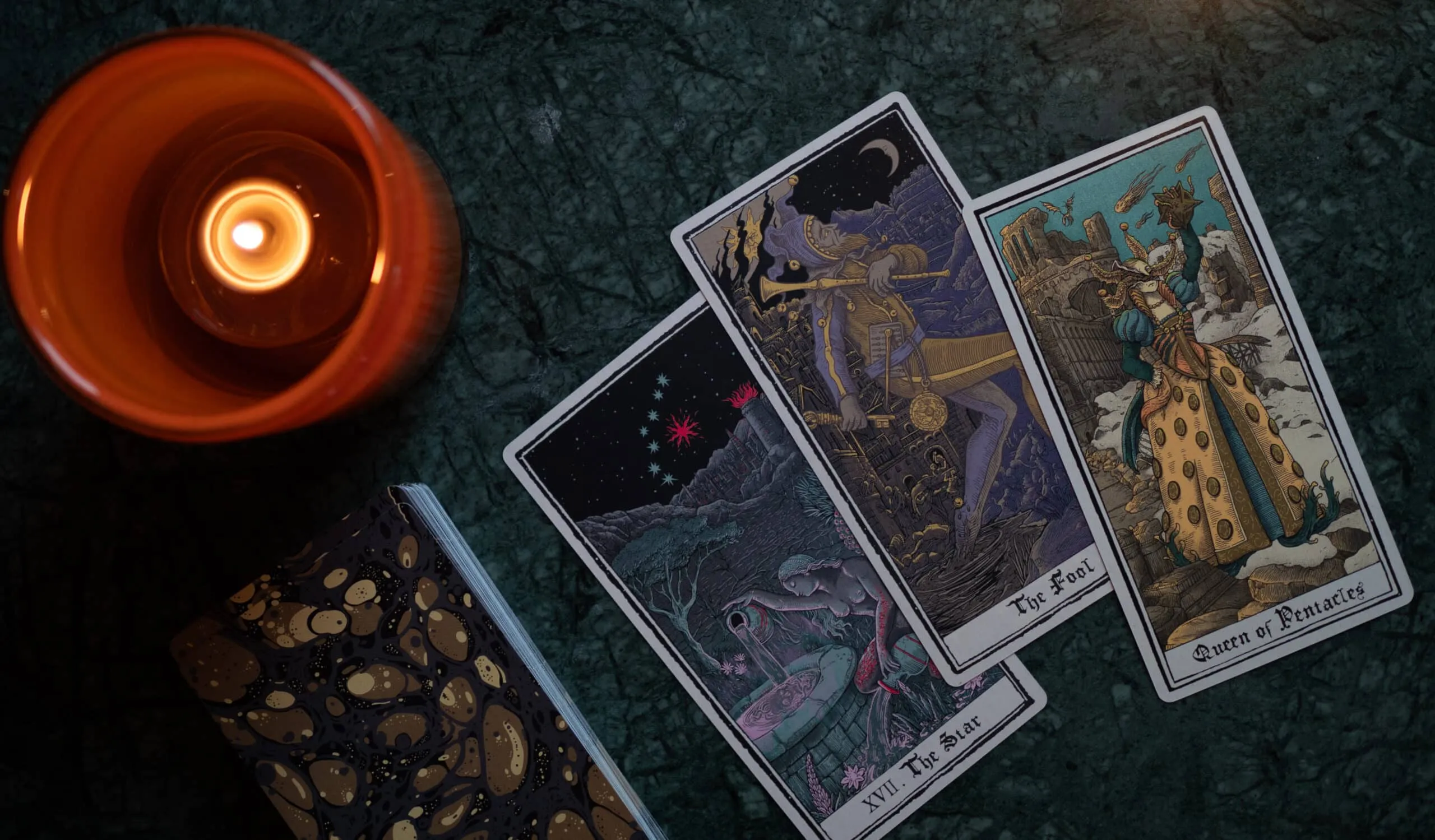
A tarot deck and an oracle deck do different jobs, and a reading that uses both is usually clearer than one that uses either alone. Tarot supplies the structure: fixed meanings, named arcana, a system you can learn and compare with other readers. Oracle cards supply the tone: looser, more personal, often more direct about how something feels. Put them together and you get an interpretation with both bones and feeling.
This guide covers how the two systems differ, how to choose decks that work together, the pairing techniques that hold up in practice, and how to keep improving at combined readings.
How the two systems differ
Tarot has a fixed structure
A tarot deck has 78 cards, and the split between them matters more than the number. The 22 Major Arcana cover the large passages of a life: the Fool setting out, the Tower coming down, the World finishing something. The 56 Minor Arcana cover ordinary days, in four suits. Cups for feeling and relationships, Wands for energy and action, Swords for thought and conflict, Pentacles for work, money and the body. Each suit carries one of the four classical elements, and each card carries a conventional meaning that most readers share. That shared ground is the reason two tarot readers can sit down and argue about a spread at all.
The pictures carry a lot of the message. On the Rider-Waite deck a figure stands bound and blindfolded with eight swords planted around her, and you understand the feeling of being trapped before you read a line of interpretation. That is what a fixed deck buys you: the same image prompts the same kind of recognition in almost everyone, so the reading has a floor to stand on.
Oracle decks have no fixed structure
Oracle decks vary in size, theme and style. Some have 44 cards, some have 60, and the meanings come from whoever made the deck rather than from a tradition that predates it. One deck is built around emotional healing, another around soul connections, another around breathwork, with every card inviting you to notice how you breathe and where you hold tension. You can buy a deck for one specific subject and use it only for that.
The freedom is the point. With no fixed system to answer to, you read what the card brings up here, for this person, on this afternoon. The trade-off is that an oracle deck travels less well between readers. Ten people can look at the same tarot card and broadly agree; ten people looking at the same oracle card may say ten different things. Your own history with that deck is the interpretive key, which is why borrowing somebody else’s oracle deck often feels flat.
What each one is good for
Reach for tarot when you want to analyse a situation in detail. The Major and Minor Arcana together give you a layered picture: what phase someone is in, where the pressure is coming from, which part is ordinary friction and which part is a larger theme they keep returning to. The depth of meaning in each card means you can take one position and spend ten minutes on it without running dry.
Reach for oracle cards for direction and tone. They answer a question like what would help here more gracefully than what is actually happening and why. In a combined reading, tarot does the diagnosis and the oracle deck does the advice. That division is why the two work so well in the same session: one covers the analytical side, the other the emotional side, and most real questions contain both.
The basics to have in place
Spreads worth knowing
A three-card spread (past, present, future, or situation, obstacle, action) is the workhorse. It holds a reading together without burying the message. The Celtic Cross goes the other way, with ten positions: the situation, the crossing influence, the foundation, recent history, the self, the near future, your own attitude, outside factors, hopes and fears, and where it is heading. Use it when the question is large and there is time to do it properly. A three-card layout gives you a snapshot; the Celtic Cross gives you the long version, and they are not interchangeable.
Themed spreads are worth building. A relationship layout can look at what each person brings, what goes unsaid between them and what the next honest step is. A career layout can ask about the obstacle, the opportunity and the strength the person already has. When you design the positions yourself, you already know what each card is answering, which removes a lot of the guesswork in the middle of a reading.
Where intuition fits
The cards set the vocabulary; you decide which meaning of that vocabulary fits. When someone reacts visibly to a card, the reaction is information, and it usually beats the book meaning. A client who flinches at the Tower and shrugs at the Devil has told you where the real weight sits. Noticing that and following it is most of what makes a reading feel accurate, and it is what people mean when they say a reader is good.
This is not an excuse to skip learning the cards. You learn the system so that you can hear when the situation is telling you to leave it. A reader who does not know the meanings is not being intuitive, they are guessing in public.
Shuffling and drawing
Shuffling mixes the deck and gives both people a minute to settle on the question. When someone sits down and draws immediately, the reading tends to come out scattered, because nobody has decided what it is about yet. Quiet while they shuffle is usually enough. Shuffling also clears the deck of the last reading, which matters more when you read for several people in an afternoon.
Then draw deliberately, turning each card knowing which position it belongs to. It sounds fussy and it changes the reading, because you notice what you were hoping to see. Draw a card for the obstacle position while privately wishing for the outcome card and you will read it as the outcome. Naming the position out loud as you turn the card keeps you honest.
Choosing decks and setting an intention
Decide what the reading is for before you put two decks on the table. If the question is whether to take a job, the tarot cards analyse the situation and the oracle deck can speak to how the person wants to live. If the question is grief, a gentler oracle deck earns its place next to a tarot deck that will not soften its answers. The intention comes first and the decks follow it, not the other way round.
Then look at the decks side by side. A densely illustrated tarot and a busy oracle deck compete for the same attention, and your eye has to work too hard to separate them. Decks that differ in register, one detailed and one plain, tend to read well together because you can tell at a glance which system a card came from.
Keep track of which pairings you used and how the reading landed. A note in a notebook is enough: the two decks, the question, and whether the combination produced anything the person could use. Three months of those notes will tell you more about your deck pairing than any review you read online.
Pairing techniques
Find the theme both decks are circling
Look for the motif that appears in both draws: change, repair, honesty, rest. If the tarot card is about upheaval and the oracle card is about new growth, the reading is about what comes after the break, which is more useful than either card on its own. The theme is the thing you say first when the person asks what the cards mean.
Some motifs come up often enough to plan for: self-discovery, healing, empowerment, letting something go. Picking cards that carry one of those themes deliberately makes the pairing easier to explain, because both cards are already pointing in the same direction when they land.
Watch the person while the cards are on the table, too. A tarot card describing the difficulty paired with an oracle card offering support gives you a balanced reading, and it is often the oracle card the person reacts to, because it is the one that offers them something.
Ask the person what they see
Before you interpret anything, give the person a minute with the layout and ask what stands out. Not what the cards mean, which they will not know, but which one they cannot stop looking at, and what it reminds them of. The answer often supplies the exact angle the reading needs, and it comes from them rather than from you.
This works because your reading of the cards carries your own assumptions about the situation. Theirs carries the situation itself. Put the two together and you get an interpretation that neither of you would have reached alone, which is the point of reading with cards in the first place rather than telling someone your opinion.
Give every position a job
Decide in advance what each slot means, and lay both card types into that structure. When a position is defined, a confusing card has somewhere to sit. This is also the honest way to read a hard subject: the challenge card sits in the challenge position instead of floating free in the middle of the table, where it can mean anything and therefore nothing.
Defining positions also makes the reading easier to follow out loud. Past influences, current situation, next step: state the position and then the card, and the person listening can keep up without holding the whole layout in their head. Half of what a client takes home from a reading is structure, not prediction.
Use the elements
Cups are water, Wands fire, Swords air, Pentacles earth. If a tarot card is full of water and the oracle card that follows is about standing your ground, the pair is about feeling something and then deciding what to do about it. Reading by element is a quick way to see which card is the feeling and which is the response, and it works even when the two decks use completely different imagery.
An earth-heavy tarot card next to an oracle card about stability keeps the reading on the ground: practical steps, money, housing, the body. It is a simple check, and it stops you drifting into abstractions.
Balance Major and Minor cards
A spread full of Major Arcana says something large is moving: a move, a break-up, a decision that shapes the next few years. A spread of Minor Arcana says the work is in the week to week. The most useful readings have both, because knowing that something large is happening is not much help until you can see the small steps inside it.
If a Major card names a period of transformation, put a Minor card or an oracle card beside it and look for the everyday decisions that period contains. That is where the client’s actual choices are, and it is where they will do something with the reading afterwards.
Read the two cards as one sentence
Do not read the tarot card and then put it down to read the oracle card. Read them together. If the tarot card names a challenge and the oracle card offers support, ask how that support answers that challenge specifically. A conflict card next to a card about peace is not a contradiction; it usually points at an internal argument the person is having with themselves, and the oracle card shows the way through it.
Combined readings earn their keep in the connection between the cards, not in either card alone. If you cannot find a connection, say so and read each separately. Forcing a link that is not there is the fastest way to lose a client’s trust.
Questions that work in a combined reading
The question decides more than the spread does. Open questions give the cards room to say something you had not considered. Questions about the largest obstacle, or about what the person actually wants, produce better material than questions about what someone else will do.
Vary the question type between sessions. Someone who always asks what will happen builds up an expectation that the cards should hand over the future, and they leave disappointed when the cards describe a situation instead. Someone who asks what would help tends to leave with something to do. Talk to the person about how they frame their question before you shuffle, because it is easier to fix at the start than halfway through.
Reversals
Two decks on the table means making a decision about method, and the simplest one works: read a reversed tarot card as a blockage rather than as the opposite of the upright meaning. A reversed card in the obstacle position often names a pattern the person keeps repeating, and talking about that pattern is more useful than talking about what the card might mean if it had landed the other way up.
Oracle cards are generally read upright, so the reversed tarot card raises the difficulty and the oracle card can suggest what would lift it. Read a reversed stagnation card and then an oracle card about movement, and you have a question and an answer sitting next to each other. Using both orientations gives the reading a balance between what is clear and what needs looking into.
Crystals, herbs and the room
Amethyst or clear quartz on the reading table is a common habit, along with sage or lavender for clearing the space between readings. Neither is required, and both matter far less than whether you are paying attention. Use them if they help you and the person sitting opposite you settle. Leave them out if they are only theatre.
Physical comfort does more work than any object on the table. Soft light, a chair the person can sit in for half an hour, and a phone face down. The aim is a room where somebody can say something difficult, and no crystal achieves that on its own.
Getting better at combined readings
Put practice sessions in the diary
Skill in this work comes from repetition with attention, not from collecting decks. A fixed slot each week for practice readings, even just for yourself, is enough to stop the two systems blurring into each other in your head. Mix structured practice with casual readings and you will notice which pairings you reach for without thinking.
Practice on real questions rather than invented ones. Reading for an imaginary client lets you skip the awkward part, which is the part you actually need to practise: a real person with a real stake in the answer, watching your face while you talk.
Keep a journal
Write down the cards, the positions and your first impressions of every session before you check any meaning. Over a few months the journal shows you your own habits: the suits you over-read, the positions you rush through, the oracle cards you keep pulling for the same question.
A page per reading is plenty. Date it, list the cards in position order, and leave a second column for what the person did with the reading afterwards. That second column is where the useful information lives, because it tells you which interpretations had consequences and which just sounded good.
Reread old sessions
Go back through past entries looking for repetition. If the same tarot card keeps appearing next to the same oracle theme for different people, that is worth examining in your own reading rather than in theirs. It might be a real pattern in your work. It might also be a rut.
Get feedback from other readers
Sit with one or two other readers and swap readings. Someone else will see a connection between your two cards that you missed, and hearing their reasoning is more useful than another book. Take the feedback on the interpretation and leave your intuition out of it for the evening.
Structured feedback works better than a general chat. Read one of your sessions out loud, cards and positions and conclusions, and ask the other reader what they would have said at each point. The interesting disagreement is rarely at the card meanings; it is at the point where the two cards meet, which is exactly the part that combined readings depend on.
Workshops and group readings
A workshop gives you the same thing faster, with someone experienced watching you read and telling you where they lost the thread. Group readings are worth it for the range of approaches on display. Watching a reader you disagree with is often more instructive than watching one you admire, because you have to work out why their reading still landed.
Sharing your own sessions in a group helps everybody, including the people who are new to it. Experienced readers forget how much of this is learned. Explaining your reasoning to a beginner will show you the steps you have stopped noticing, and those are usually the steps worth writing down.
Review what worked
Keep track of which pairings and spreads produced something the person actually used. If a particular combination of a tarot card and an oracle card reliably opens up a difficult conversation, that is worth knowing and reusing. If a spread consistently produces blank looks, retire it.