
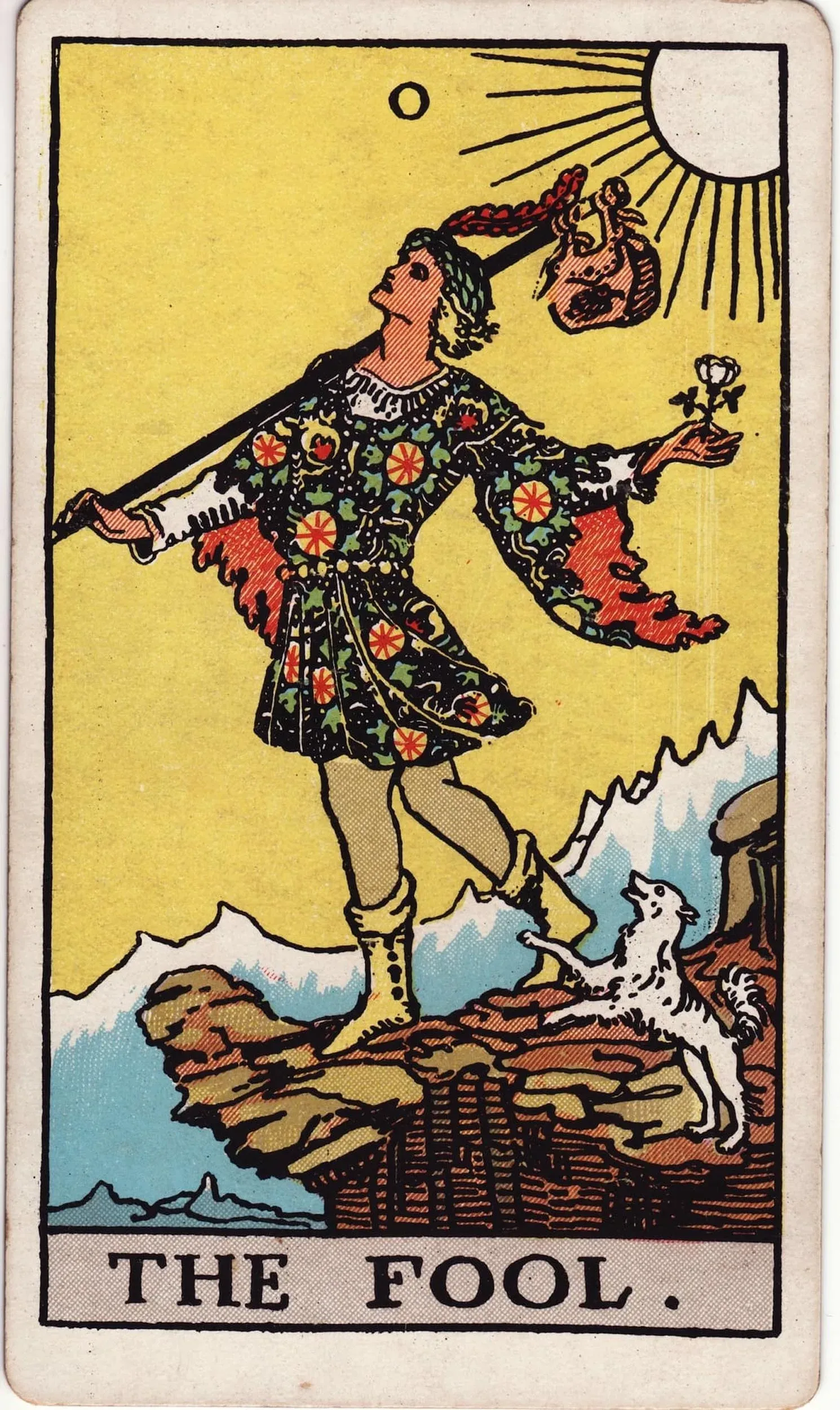
The Fool is drawn at the edge of a cliff, mid-step, with a small white dog jumping at his heels. He carries a bundle on a stick and a white rose, and he is looking up rather than down. The sun is behind him and the drop is in front of him. The card names the moment before something begins, when nothing is settled and you go anyway.
What the Fool says upright
Upright, the Fool is a beginning with no guarantees attached. It turns up around new jobs, moves, relationships, and creative work that has no plan yet. The cliff is real and so is the dog barking at his heels. The small dog is often read as instinct, following along with no more of a plan than he has. The card simply says that certainty is not on offer, and waiting for it costs you the start.
Fool energy is easiest to see in hindsight, which is why the card often appears after a decision rather than before one. It also asks about trust, in your own judgment and in the people travelling with you.
What the Fool says reversed
Reversed, the Fool usually points at a leap that has not been thought about at all. Enthusiasm without preparation, promises made on a good day, a plan with no money behind it. Naivety belongs here too, where enthusiasm meets a situation that needed reading first.
It can also read as the opposite, which is hesitation. Somebody standing at the edge for a long time, finding a fresh reason to wait every few weeks. Which reading fits depends on the rest of the spread, and the questions below tend to sort it out. Both point the same way, which is towards looking before you step.
Questions to ask in a reading
- What am I being asked to begin, and what is really holding me back?
- Am I leaping, or am I avoiding the edge?
- What would I do if I trusted my own judgment here?
- What is the smallest version of this leap I could take first?
How it reads with the other cards
The Fool with the Magician is the beginning plus the means to do something with it. With the World a long journey is finishing and another can start. Beside the Two of Pentacles the reading usually shows a risk being juggled against ordinary commitments, which is where most real leaps happen.