
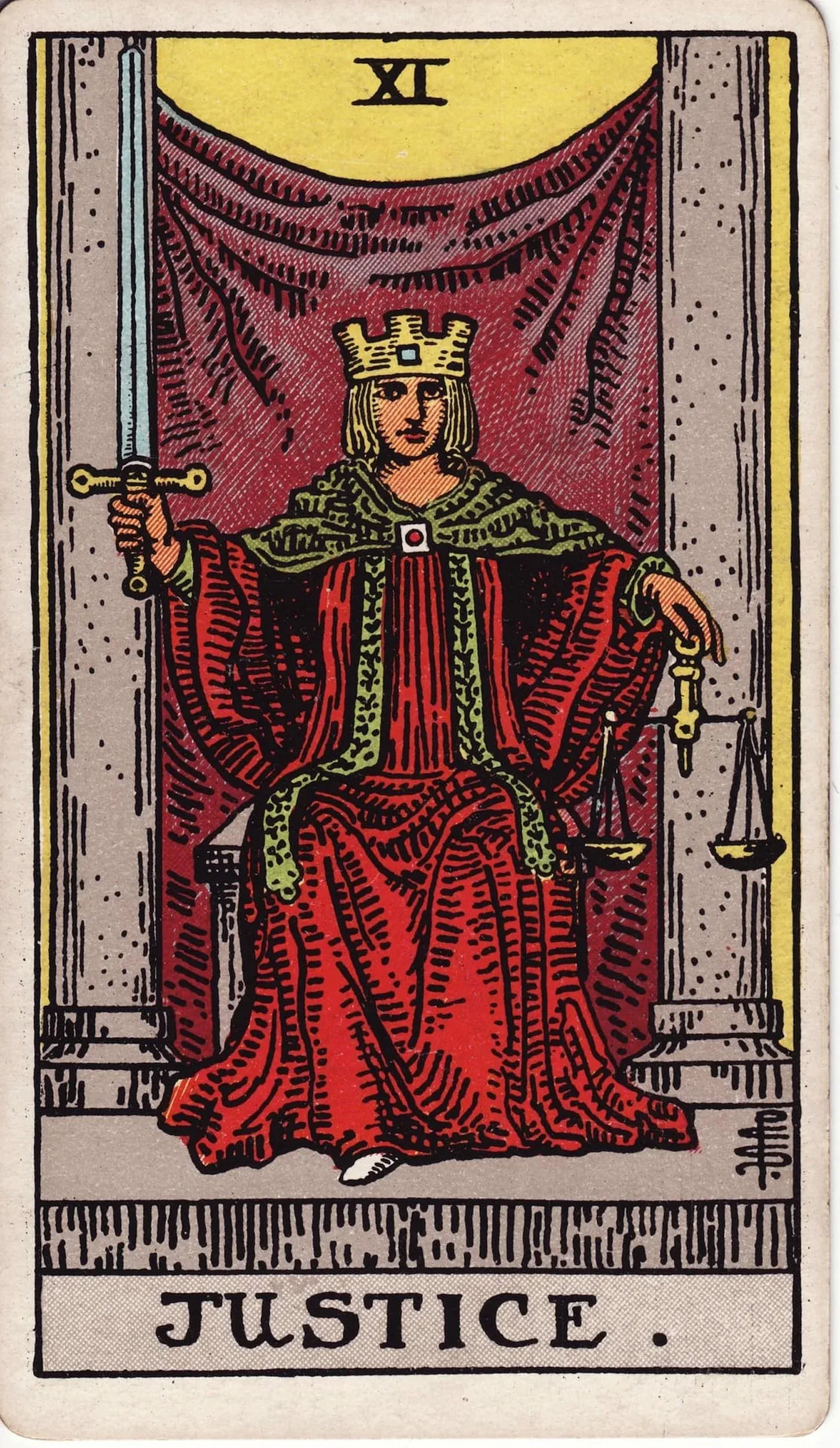
Justice sits between two pillars with a sword in one hand and a pair of scales in the other. The blade points up, the pans are level, and she looks straight ahead rather than down at what she is weighing. In a reading the card names a situation where the honest answer matters more than the comfortable one, and where something has to be weighed before anyone can move on.
What the Justice card says upright
Upright, Justice brings matters into the open. It covers contracts, legal questions, formal agreements, and any decision made by someone with authority over you. What it says is that the outcome will follow the facts, so the work is to get the facts right. Read the small print, keep the receipts, and say what you actually did. Written agreements carry more weight here than assurances given in conversation, so keep the emails.
On a personal level the card asks for accountability. You may be weighing a choice, or living with the result of one you already made. Either way, Justice is less interested in what you meant than in what happened. Honesty tends to make the situation simpler, even when it costs something.
What the Justice card says reversed
Reversed, Justice describes a scale that is loaded. One side is being given more weight: a bias nobody will admit to, a version of events that leaves out the awkward part, or a decision taken before the evidence arrived. Legal matters can drag or go one-sided, and so can arguments inside a family or a workplace. The uncomfortable reading is that you are the one avoiding a fair look, perhaps by blaming circumstances or by keeping a fact to yourself. Until that changes, the imbalance stays.
Questions to ask in a reading
- What am I not saying out loud because it would cost me something?
- Who decides this, and on what basis are they deciding?
- What evidence would change my mind about my own side of it?
- Which part of the story am I still refusing to look at?
How it reads with the other cards
Next to the Two of Swords, Justice is the verdict that the stalemate was waiting for. With the Emperor it points to rules, institutions, or a person used to being obeyed. The Five of Swords usually warns that winning this particular argument would cost more than it returns.