
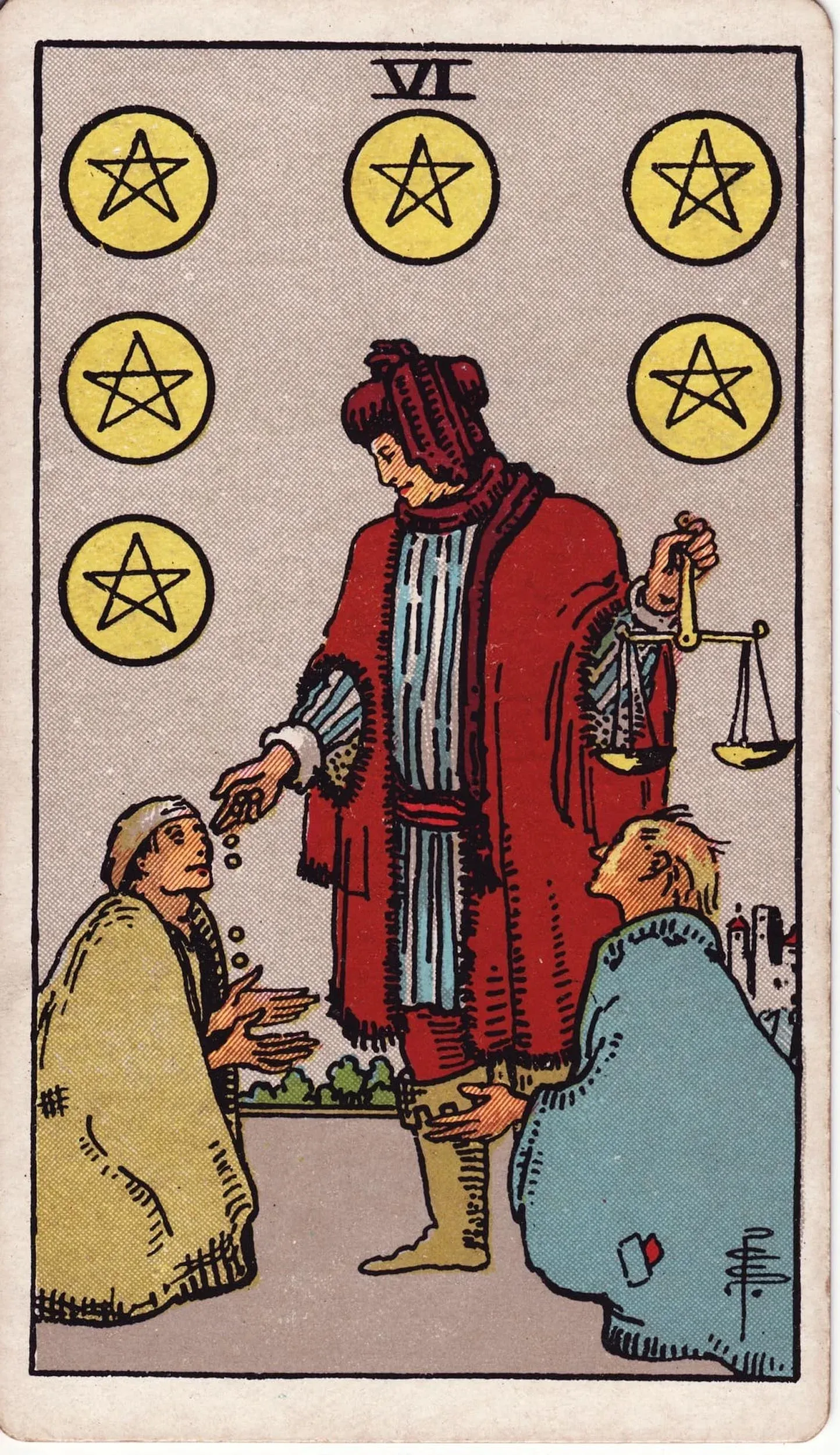
The Six of Pentacles shows a man in a red robe holding a set of scales in one hand while his other hand drops coins to two kneeling figures in rags. It is one of the few cards where money is visibly moving from one person to another. The scales matter as much as the coins, since they say the giving is meant to be weighed fairly. The card turns up for generosity, loans, favours, wages, and any situation where someone has more than someone else.
What the Six of Pentacles says upright
Upright, the card asks you to look at who holds what. You may be the one giving at the moment, in money, time or attention, or you may be the one receiving, and both positions can appear in the same reading. The exchange works when it is honest on both sides: help offered without strings, and help accepted without shame.
The scales make it a card about fairness as well. A wage, a loan between friends, who always drives, who always visits: what you are weighing is whether the balance is real or only looks that way. Support that runs in one direction for years is an arrangement, however generous it looks.
It also holds the longer view. Fortunes rise and fall, and the person kneeling today may be the one holding the coins later.
What the Six of Pentacles says reversed
Reversed, the scale tips. Someone is giving far more than they get back, or giving with conditions attached so the other person has to stay grateful and stay put. Loans with strings, favours brought up in every later argument, a boss who acts generous while paying badly: the card sees all of it.
It can also describe charity that keeps the receiver dependent, because being needed is more comfortable than being equal. When it lands this way, the question is about motive, and about whether you want the arrangement to continue as it is.
Questions to ask in a reading
- Am I the one giving here, and am I honest about what I want in return?
- What do I owe, and who decided that?
- Has the balance in this relationship quietly shifted, and when?
- Where could I accept help without turning it into a debt?
How it reads with the other cards
The Five of Pentacles beside it turns the exchange into rescue, since that card shows the moment when someone has nothing and the help is close by. With the Three of Pentacles the giving is fair work fairly paid, and with the Ten of Pentacles it becomes a question of family and inheritance.
Six of Pentacles as feelings
In a feelings reading, the Six of Pentacles often describes someone who wants to help, make room or offer something useful. They may show affection by showing up with a practical solution rather than by making a dramatic declaration. That is a real form of care, but the scales in the picture ask whether the offer leaves both people with a say. Is this person listening to what you need, or deciding for you what help should look like?
If you asked how you feel, the card can reveal a wish to be generous mixed with a worry about being needed too much. You might love giving and still resent that you are always the one making plans. It can also be hard to receive without feeling you owe a performance of gratitude. The card invites you to name both sides honestly.
Reversed, feelings may come with an invisible invoice: “After all I have done for you” is the sentence to listen for. That does not prove someone is calculating or uncaring. It gives you a useful question to test against their behaviour. Can either person say no to an offer without being punished for it later?
Six of Pentacles in love and relationships
In a relationship spread, this card is less about equal amounts than about a fair exchange over time. One person may earn more while the other carries more care work. The numbers will not always match, yet both people should be able to describe the arrangement without shrinking. Look at time, emotional attention, household work and the freedom to ask for support, not just money.
For someone dating, the card can point to a generous beginning. A person pays for dinner, remembers a small need or makes time when it is inconvenient. Notice whether they can receive a kindness too. A connection where one person must always be rescuer and the other must always be grateful has very little room to grow.
If the card is reversed, talk about terms instead of guessing motives. Perhaps a gift has become leverage, or perhaps one partner feels unseen because their less visible work is taken for granted. Ask what each of you gives, what each needs and what is difficult to request. The card cannot tell you whether a relationship will last; it can show where the balance needs attention now.
Six of Pentacles yes or no
The Six of Pentacles is a conditional yes when the question is about accepting support, making an offer or entering a fair agreement. There is something available to exchange. The condition is that you know what is being offered, by whom and on what terms. A loan, a favour and a gift can look the same at the moment they are handed over and feel very different later.
If you asked whether to give, the answer is closer to “yes, if you can give freely.” If you already expect repayment that has not been discussed, say so before you commit. If you asked whether to accept, check whether the help increases your choices or makes you answerable to the giver. Reversed, pause and clarify the agreement before treating the card as a yes. In either orientation, your actual circumstances carry more weight than a one-card verdict.
Six of Pentacles reversed: what to do about it
Start by writing down the exchange in plain terms. What has each person contributed in the past month, and what was understood about repayment or thanks? The point is not to keep score forever. It is to replace a fog of obligation with a conversation both people can have. If the issue is a loan, put the amount and repayment date in writing. If it is time or care, name a concrete change you would notice.
You may discover that the imbalance is temporary and willingly shared. Someone recovering from illness will need more than they can give for a while. That is different from an open-ended arrangement where one person cannot ask for anything. If you are the giver, ask whether you can step back without resentment. If you are the receiver, ask whether you can decline an offer and still keep the relationship.
The reversed card also asks about dignity. Help that publicly embarrasses someone, controls their decisions or must be repaid with loyalty is expensive help. When you can, look for support that lets the receiver remain an equal participant.
Six of Pentacles in career and money
At work, the scales can be literal: pay, credit, training, budget or the distribution of tasks. A manager may be willing to invest in you, or a colleague may share knowledge that changes your prospects. Ask what the organisation gets back and whether the arrangement is stated clearly. An opportunity can be good and still deserve a careful look at the terms.
If you are negotiating pay, do not let praise stand in for a number. Bring evidence of your contribution and ask for a specific change. If you are the one with the budget or authority, consider who repeatedly receives support and who has to prove themselves again each time. The card is interested in the structure of generosity, not only the generous gesture.
Reversed, it may point to underpayment dressed up as mentorship, unpaid labour labelled a favour, or a debt that has begun to govern your choices. That does not mean quitting is the next move. It means getting the figures and expectations into the open, then deciding what you can accept. A good reading ends with a practical question: what would a fair exchange look like by the next review or conversation?