
Online Tarot Readings
Evaluating the Accuracy of Online Tarot Readings
Home » Vox Insights » Insights » Evaluating the Accuracy of Online Tarot Readings
Can a reading over a video call be as good as one done face to face? It is a fair question, especially when you are paying for the session. My answer, as someone who reads online: the medium matters far less than the reader, and less again than what you bring to it. This page covers how accuracy works in an online tarot reading, how to judge a reader before you book, and how to tell a useful reading from a flattering one.
The short version
- An online reading uses the same deck and the same practice as a face-to-face one.
- The reader’s skill carries most of the weight.
- A clear question and an open mind do more for a reading than any technique.
- Video calls let you read from home and go back over it afterwards.
- The cards suggest what is possible; they do not hand you a fixed future.
How an online tarot reading works
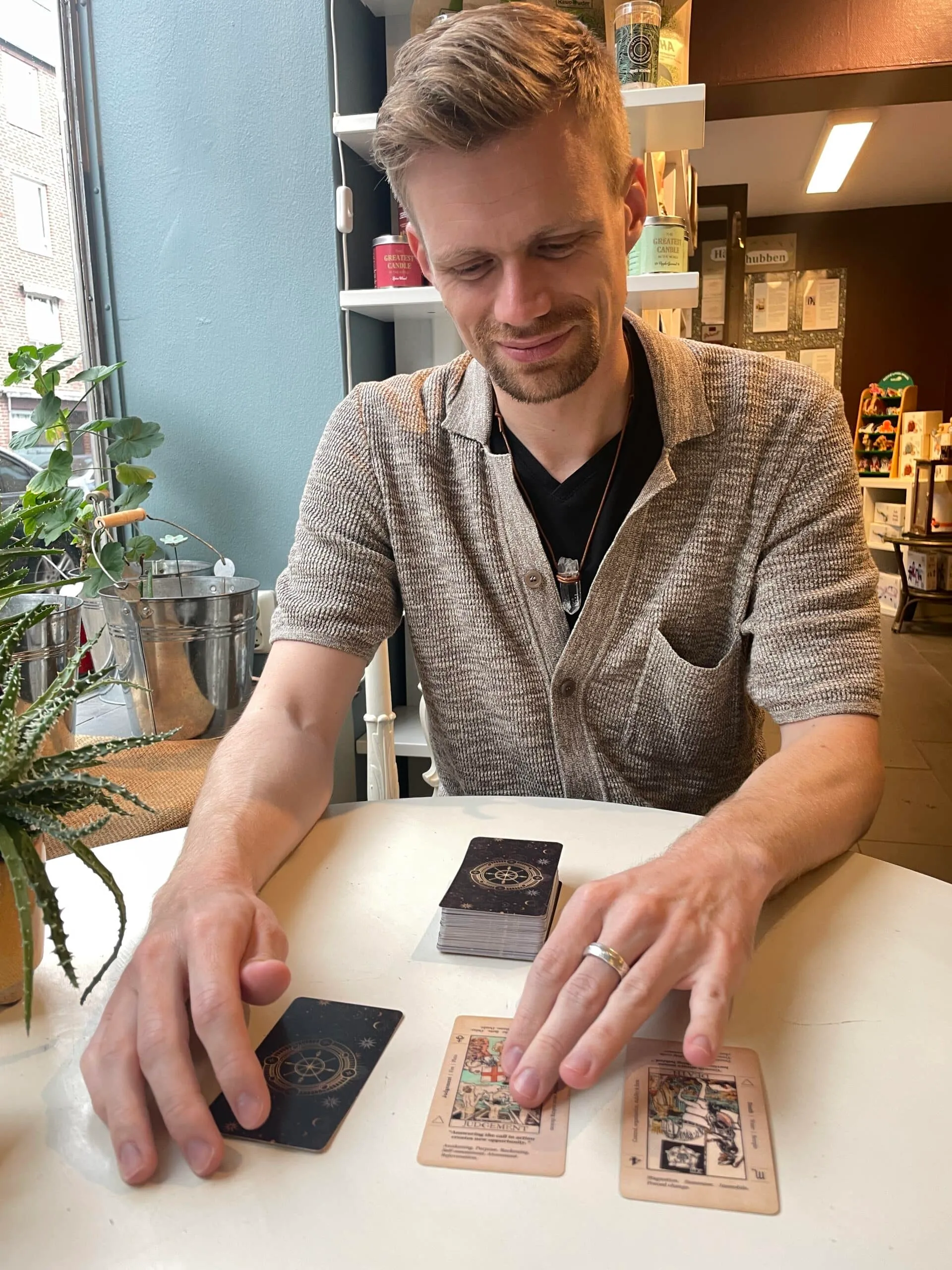
The practice is unchanged. You book a time, settle somewhere you will not be interrupted, and the reader shuffles and lays out cards. On a video call you can see each card as it lands, ask questions as they occur to you, and talk about what the spread seems to be pointing at. The difference is where you are sitting, not what the cards do.
A session usually runs something like this:
- You settle on a question, or on an area of your life you want to look at.
- The reader shuffles and draws.
- The cards go into a spread.
- The reader reads each card, and then how they relate to one another.
- The two of you talk about what came up, and what you might do with it.
Spreads organise the question. One card suits a quick check-in. Three cards give you past, present and future, or a situation and the ground it stands on. The Celtic Cross, ten cards, is for when you want the whole picture in one go. Love, work and decisions each have their own versions of these layouts, and underneath they work the same way.
How to judge a reader before you book
There is no licence for tarot readers, so credibility comes down to what you can see and read for yourself. Three things are worth your attention.
Experience, and how they describe it
Look at how a reader talks about their own practice: how long they have been reading, which systems they learned with, and whether they sound like someone reading cards or someone performing certainty. A reader who has spent a long time with the deck tends to talk about the cards themselves.
Reviews and testimonials
Read several reviews rather than the one quote on the front page. A page of reviews that all say “amazing” tells you less than one that describes what the client asked about and what changed afterwards. Consistency across a handful of reviews tells you more than enthusiasm in any single one.
Price, format and what you are buying
A straightforward reader tells you how long a session lasts, what it costs, and how to book. If the price is hard to find, or a reading comes bundled with something you did not ask for, take that as information about how the session itself will run.
What affects the accuracy of a reading
The reader
Experience shows in how someone handles the awkward cards. A reader who has worked with the deck for years can hold two or three possible readings of one card and choose the one that fits what you have told them. They have also learned to say when a card is not clear yet. Intuition is part of it, and so is plain familiarity: knowing how one card changes the next one in a spread comes from repetition rather than a gift.
What you bring to the session
The person asking matters as much as the reader. Come with a real question and a willingness to hear something you did not expect, and the reading goes further. Come looking for permission for a decision you have already made, and the cards will usually oblige, which is not the same thing as being useful.
Vagueness is the other obstacle. “What does my future hold?” gives a reader nothing to aim at. A question with a subject and something at stake in it gives them plenty.
| What you come with | A card that might appear | How to read it |
|---|---|---|
| A decision about work | The Fool | A new start is on offer, so weigh what it asks of you |
| Trouble in a relationship | The Lovers | The choice matters more than the person |
| A wish for more time to yourself | The Hermit | Step back before you decide anything |
Which deck is used
Deck choice changes how a reading feels more than whether it is accurate, but it is not nothing. Some readers stay with the Rider-Waite-Smith images their whole life. Others move to decks with different art, or to themed decks built around a single idea. The pictures are what the two of you are looking at together, so a deck whose images say something to you gives you more to work with.
Online compared with reading in person
What you gain
- Access to readers anywhere, rather than only the ones near you.
- Your own space, which for many people makes it easier to speak plainly.
- A recording or a set of notes you can return to once the session has settled.
- Time afterwards, at home, to think about what came up.
What you lose
- The reader cannot pick up on what a room gives away: a pause, a change of posture, the point where a question lands harder than expected.
- A poor connection or a flat battery can break the flow in the middle of a spread.
- A long spread takes more patience when the cards are on a screen.
Somewhere in between
Some readers work across both, with cards drawn digitally, or drawn at their end, and the conversation on a video call. It suits people who want a live session without the travel, and it lets a reader work with clients in another country without either side needing to be in the same room.
Getting more out of a reading
Ask a question with an edge
Questions beginning with “how” or “what” go further than questions beginning with “will”. Compare “Will I meet someone this year?” with “What do I keep getting wrong about the people I choose?” The first asks for a prediction. The second gives the cards something to work on.
Before the session, take ten minutes to sit with your question and write it down. That small ritual does more for a reading than any trick for getting the cards to talk.
| Type of question | Example | What it does |
|---|---|---|
| Specific | “How can I make this job bearable for now?” | Points the reading at one part of your life |
| Open | “What can I do to be luckier in love?” | Leaves room for an answer you had not considered |
| Time-bound | “What should I focus on over the next three months?” | Gives the reading a horizon |
Pick a moment when you can be present
Timing matters for practical reasons before any other: you want a quiet half hour and nowhere else to be. Some people also like to line a reading up with a full moon, a birthday or the turn of a season, and there is nothing wrong with that if it helps you take the session seriously. The state of mind matters more than the date.
- New moon: setting intentions
- Full moon: looking back and closing something off
- Equinoxes: balance and transitions
- Birthdays and anniversaries: a review of the year
Say what you notice
If a card makes you uncomfortable, or you cannot stop looking at one image, say so during the session. That reaction is information, and a good reader will use it. You do not need to know any tarot to take part. You only need to be willing to say what you see and to ask about what you do not understand.
Common misconceptions
Online readings are a lesser version
The cards do not know whether you are in the same room. What an online session lacks is physical presence, not access to the deck. Plenty of readers work this way now, and the readings can be as detailed as any face-to-face session.
| Factor | What it affects |
|---|---|
| The reader’s skill | How much the spread can say |
| Your openness | How much of it lands |
| The connection and the setup | How smoothly the session runs |
Tarot is only fortune telling
People who have never had a reading often assume it is about being told what happens next. Most of a session is spent on what is already happening: a pattern in how you choose partners, a job you have outgrown, a decision you keep postponing. The cards describe the shape of a situation and the options inside it. If you want a prediction, that is the least durable part of the reading.
Any reader will do
Readers differ more than decks do. One is good with relationship questions and blunt about it. Another is better on work and takes longer to say anything. Their training, the decks they use and the way they talk all vary. If a reading does not land, that can be a mismatch between you and the reader rather than a verdict on tarot.
Frequently asked questions
Can an online reading be as accurate as an in-person one?
The cards are the same and the practice is the same. What is missing online is the shared room, and what you gain is reading from your own space at a time that suits you. Any difference in quality comes down to the reader and to how open you are, not to whether the session happens on a screen.
What affects the accuracy of a reading?
Three things matter most: how experienced the reader is, how clear your question is, and how willing you are to hear something uncomfortable. Deck choice and the spread matter less than people expect.
How do I know an online reader is credible?
Look for a reader who sets out their experience, shows several specific reviews, and states plainly what a session costs and how long it lasts. Be wary of anyone who guarantees an outcome.
Which myths should I ignore?
Two come up constantly: that online readings are inferior, and that tarot is only fortune telling. Neither holds. The cards work as a way of examining a situation, and they work the same whether the reader is across a table or on a screen.
How should I prepare?
Find a quiet half hour, write your question down, and bring it as it is. You do not need to know the cards, cleanse anything, or believe anything in particular. Turn up, say what is on your mind, and ask when something is unclear.