
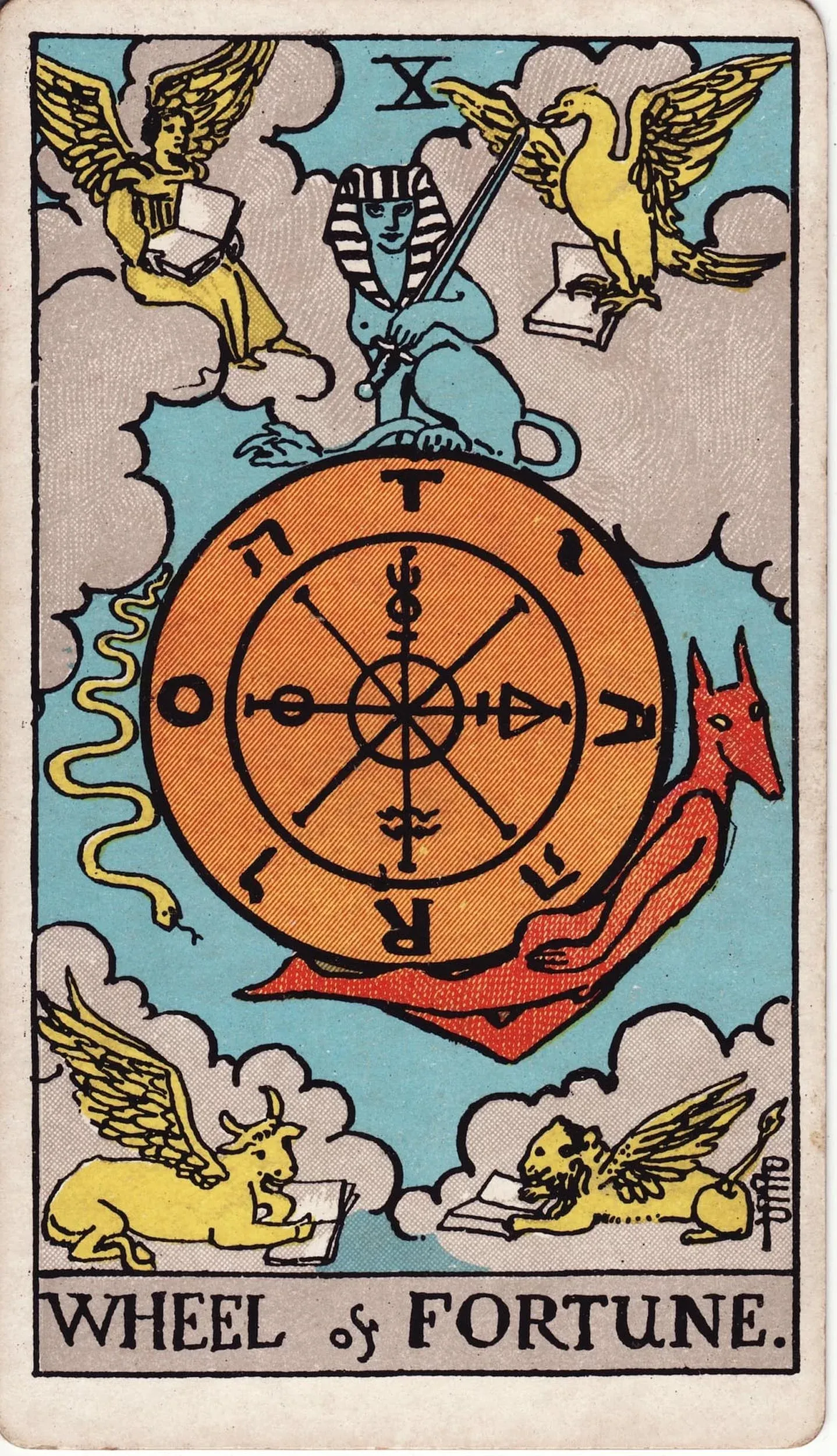
A great wheel turns in the sky, marked with letters and symbols around its rim. Four winged figures sit in the corners, each reading from a book. The wheel has no handle. The card names a change that arrives from outside the person’s control, and the plain fact that nothing stays where it is.
What the Wheel of Fortune says upright
Upright, it is a card of movement and timing. Something shifts, often with little warning, and the situation the person was managing a month ago is not the one in front of them now. It can mark a run of good luck, a chance meeting, or a decision made elsewhere that changes the picture at home.
Fortune in the older sense means more than money. The card covers cycles: seasons of work and rest, and the point where effort and circumstance line up. It tends to appear when a person has done what they can and the rest is out of their hands.
It also carries a warning about credit. When things go well under this card, the person did not cause all of it. When things go badly, they did not cause all of that either.
What the Wheel of Fortune says reversed
Reversed, the wheel feels stuck. Plans meet delays, effort seems to go nowhere, and the same problem returns in a slightly different shape. It can point to a run of bad luck, though just as often it describes someone fighting a change that has already happened, still holding on to a version of a relationship that ended months ago.
The card asks about response. Nothing in the image suggests the wheel can be stopped. Where it appears reversed, the useful question is usually what the person can control this month, and how much energy is going into arguing with the rest.
Questions to ask in a reading
- What has changed recently that I have not accepted yet?
- How much of this is within my control this month?
- What am I waiting for, and is it likely to arrive?
- What did the last good stretch teach me that I could use now?
How it reads with the other cards
The Wheel sits next to the Hermit in the major arcana, where the pause is deliberate and the person sets the pace, and with Death, which is the more final version of the same theme. Next to the Ten of Pentacles, the change touches family or property. With the Two of Pentacles, the person is already juggling and the wheel adds a variable.