
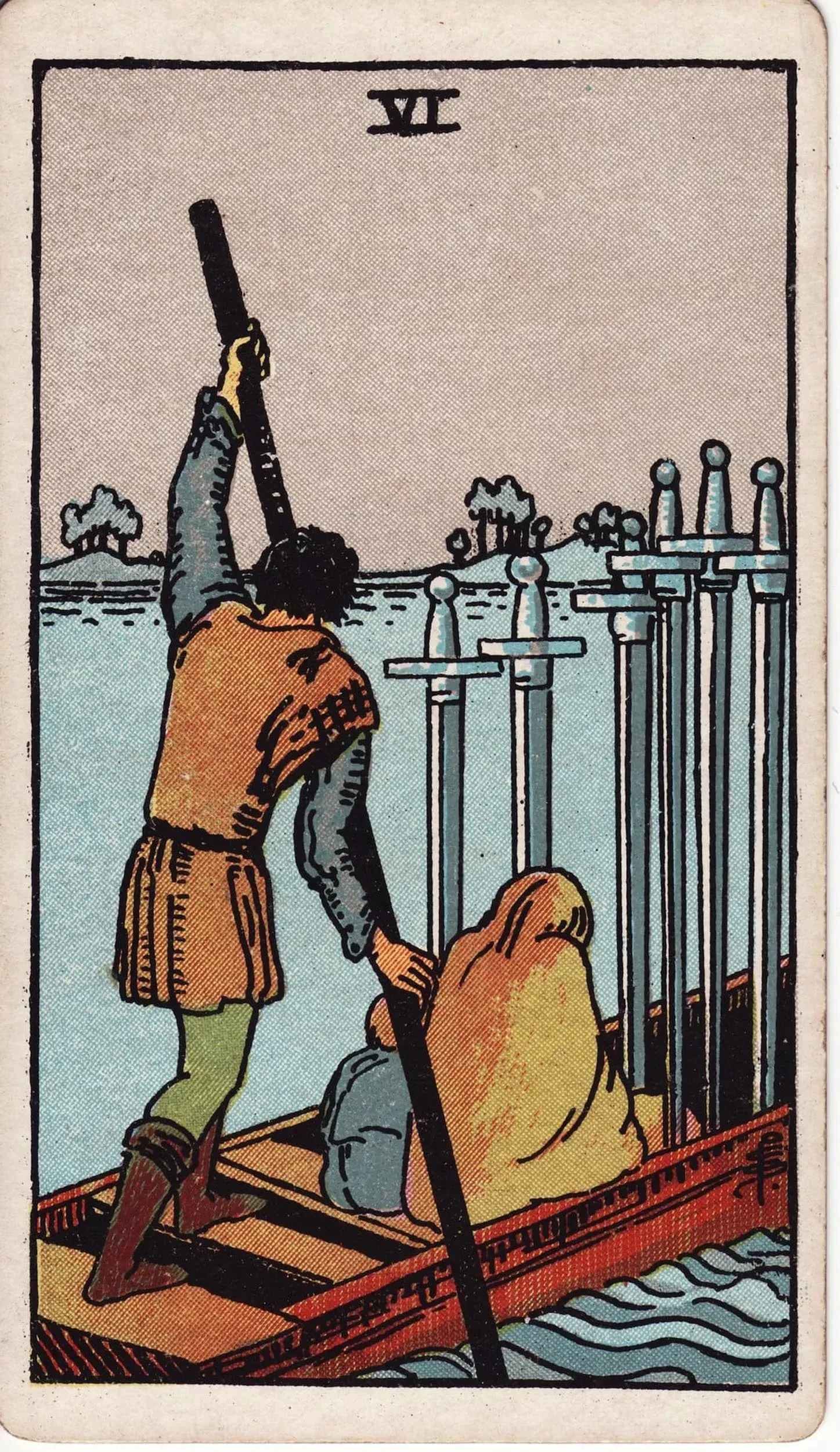
The Six of Swords shows a boat being poled across water, carrying a woman wrapped in a cloak and a child beside her. Six swords stand upright in the hull, and the water grows calmer as the boat moves. Nobody in the boat looks cheerful, because this is a crossing made out of necessity. The card names the period just after something difficult, when you are on your way somewhere better and not there yet.
What the Six of Swords says upright
Upright, the worst part is behind you. Something has been left: a job, a relationship, a city, a way of thinking that was making you ill. The crossing itself is uncomfortable and rarely looks dramatic from the outside. Moving house, ending a friendship, finally seeing a doctor, taking the quieter version of a job: this is the kind of change the card describes.
The swords in the boat deserve a second look. You carry your thinking with you, including the parts you would rather leave behind, so the change of scene does the first half of the work and the rest is yours. Recovery also takes longer than the journey.
What the card promises is calmer water and a clearer view, reached by your own effort at the pole.
What the Six of Swords says reversed
Reversed, the boat is not moving. You may have decided to leave and not left, or you keep returning to something whose ending you already know. Unresolved business is the usual reason: an argument never had, a debt never settled, a conversation you keep rehearsing and never start.
The fear underneath is often about the unknown, and staying put feels safer even when it is worse. Small steps work better than deciding to change everything at once, and naming what you are actually afraid of unblocks the rest.
Questions to ask in a reading
- What am I still carrying that I did not have to bring?
- If I am not moving, what happened the last time I tried?
- What would the first small step look like, if I stopped planning the whole journey?
- Who is in the boat with me, and are they helping?
How it reads with the other cards
With the Ten of Swords, the crossing follows a complete ending, since that card is the floor of a bad situation. Next to the Two of Swords or the Eight of Swords, the same journey has not started and the reading turns to what is being avoided.