
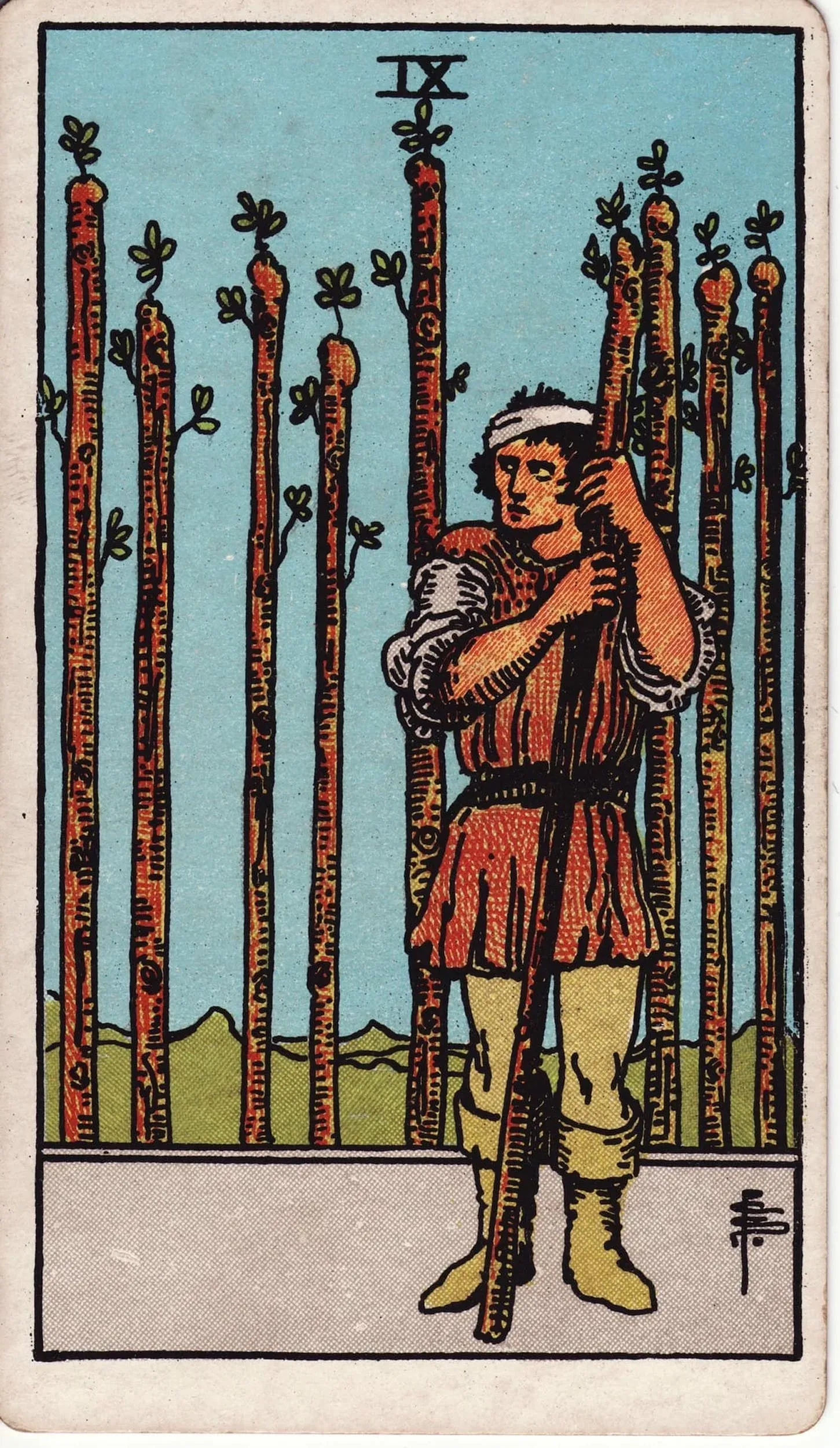
The Nine of Wands shows a man with a bandage around his head leaning on a staff, with eight more staves planted behind him. He is looking back over his shoulder. Whatever fight he has been in, he won it, and he has not put the staff down. The card comes up when you are nearly through something long and tiring and cannot quite believe it is over. It is the last stretch of a hard year rather than the end of one.
What the Nine of Wands says upright
Upright, this is the card of the person still standing. You have taken hits and kept going, and there is a guardedness about you now that was not there before. The card often appears when someone is defending a position they fought for: a boundary with family, or a role at work they had to argue for.
It speaks to the value of experience too. The eight staves behind the man are everything he has already survived, and he stands taller than all of them. If you are wondering whether the effort was worth it, this card says you are further along than you think.
What it does not promise is ease. The man is still holding the staff. There may be one more thing to get through, and the advice is to hold the line you have already chosen rather than open a new front.
What the Nine of Wands says reversed
Reversed, the exhaustion wins. You are tired in a way that sleep does not fix, and the defensiveness that used to protect you is now keeping people out. This is the card of the person who snaps at a simple question because they have been braced for too long.
It can also mark the point where a fight continues out of habit. The card asks whether the argument is still about the thing it started as. Sometimes the honest move is to put the staff down and rest.
Questions to ask in a reading
- What am I defending, and is it still worth defending?
- Where am I running on momentum rather than on purpose?
- Who could I safely let past the fence?
- What would real rest look like this week?
How it reads with the other cards
With the Ten of Wands it becomes a picture of a very long haul, close to the end but without relief. Next to the Star the reading softens, because recovery has already begun. Paired with the Tower, the defences come down whether you choose it or not.
Nine of Wands as feelings
As feelings, the Nine of Wands often shows a person who is still present but wary. They may care and still brace for the next disappointment. The figure in the card has been hurt and keeps a hand on the staff; their caution comes from experience. That can deserve compassion without requiring you to prove yourself endlessly.
If you asked about your own feelings, notice whether you are protecting something important or simply expecting a familiar injury. Those can feel identical from inside. What has actually happened in this relationship, and what belongs to an earlier one? The card asks you to check the fence before deciding whom to let through.
Reversed, vigilance may have become exhaustion. A person might withdraw because they cannot bear one more difficult conversation, or keep arguing because stopping would feel unsafe. The card does not reveal another person’s private intention. It can help you name the cost of staying on guard and ask what would make genuine rest possible.
Nine of Wands in love and relationships
In a relationship spread, this card may appear after repeated conflict, illness or a period when trust needed constant repair. It shows endurance, but endurance is not the same as a healthy bond. Ask what has changed since the last hurt. Are both partners doing work to make the relationship safer, or is one person simply getting better at absorbing the strain?
For someone dating, the Nine can describe a person who approaches closeness carefully. Patience may help, but there should be room for your needs too. You can respect their history and still ask for clarity about what they can offer now. Neither of you has to earn love by surviving an indefinite test.
Reversed, the fence may be too high or too low. You might refuse any vulnerability, or let the same boundary be crossed until you are too tired to object. Choose one boundary you can state plainly and keep. A good relationship should allow caution to soften with evidence, not demand that it disappear on command.
Nine of Wands yes or no
The Nine of Wands leans yes to finishing an effort that is close to its end, provided you still have the resources to do it safely. It is a card of persistence with a warning built in. Ask how much remains, who can help and what rest is needed. “Keep going” is useful only when you know what you are going toward.
If the question is whether to continue a conflict, the answer is less clear. You may be defending a boundary that matters, or repeating a fight that has stopped serving you. Reversed, pause before committing more energy. The card may ask you to recover, change tactics or admit that a finish line has moved. A one-card yes or no should not overrule signs of burnout or harm.
Nine of Wands reversed: what to do about it
Count the demands on you. Which are unavoidable, which can be delayed and which belong to someone else? When you have spent a long time holding a position, every request can sound urgent. Put the tasks in writing and choose one thing to release or share this week. Rest works better when it is scheduled than when you wait to collapse.
Then examine what you are defending. If it is a principle, a person or a commitment you still choose, ask what support would help you protect it without standing alone. If it is only a habit of expecting attack, experiment with one low-risk moment of openness. You do not have to lower every guard to learn whether this situation is different.
Reversed Nine of Wands can also mean that a boundary needs enforcing rather than another explanation. State the limit, the action you will take if it is crossed and what would allow trust to grow again. The card’s advice is practical: protect your energy so it can serve something worth keeping.
Nine of Wands in career and money
At work, the Nine often appears near the end of a demanding project. You know how much has already been done, and you can see how much is still expected. It may encourage one final, well planned push. It also asks whether the deadline is real and whether everyone understands the cost of meeting it.
If you manage a team, do not praise resilience while quietly making exhaustion the normal schedule. Identify the work that matters most, arrange cover and make recovery part of the plan. If you are an employee, document the workload and ask for a concrete adjustment. Endurance should be visible, not taken for granted.
For money, this card may describe protecting a hard-won buffer. Caution is sensible, especially after a difficult period, but fear can also stop you from using resources for the purpose you saved them. Reversed, review the plan with current figures rather than an old emergency in mind. The aim is a level of protection that lets you live, not a permanent state of siege.