
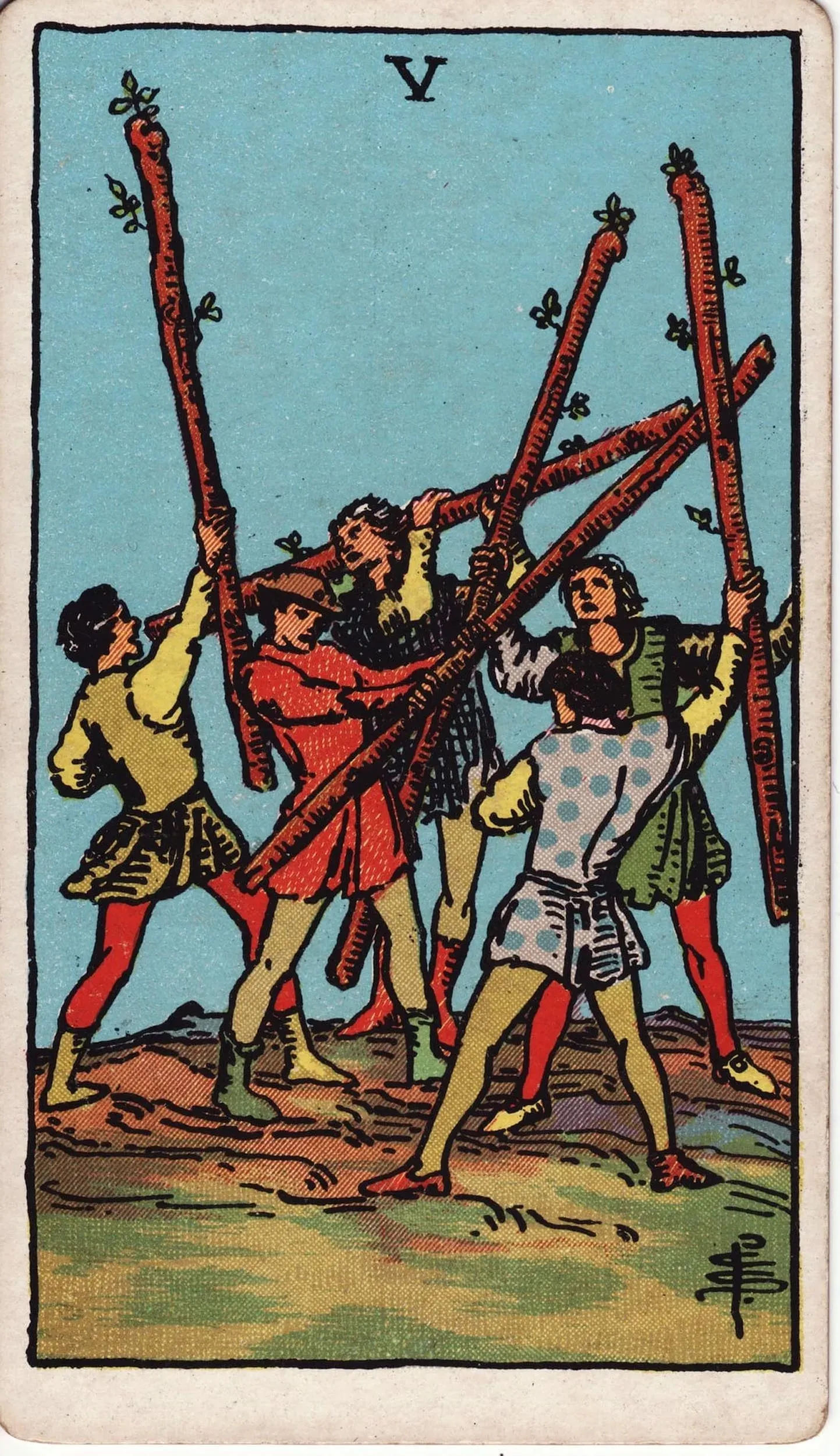
The Five of Wands shows five figures with staves held up, the staves crossing each other in the air. Nobody is clearly winning and nobody looks badly hurt. The scene has the feel of a scuffle that started over very little. In a reading it names friction: competing voices, or effort spent on the argument instead of the work.
What the Five of Wands says upright
Upright, the card points to competition and disagreement. Several people want different things from the same project, or the same thing, and nothing has been settled. It shows up in groups where everyone talks over each other, and in your own head when two parts of you want opposite outcomes.
There is energy in the card, and it is not all bad. Friction can sharpen an idea that had gone slack, and a competitive streak can get something moving that polite agreement would have left alone. What the five asks is whether the argument has a purpose. The skills it needs are ordinary: negotiating, and knowing which argument is worth having.
What the Five of Wands says reversed
Reversed, the Five of Wands usually means the fighting has stopped, either because it was settled or because everyone walked away. Sometimes it reads as relief after a tense stretch. When that happens, some of the energy that was going into the argument becomes available for something else.
In a group reading it more often asks whether the quiet is real. Silence that comes from people no longer bothering to say what they think is not the same as agreement, and the card tends to notice the difference. Where the situation allows it, the card points towards teamwork and towards some shared ground both sides can live with, which is generally smaller than either of them expected.
Questions to ask in a reading
- What is this disagreement actually about?
- Am I competing with someone who is not playing the same game?
- Would speaking up make things better, or only louder?
- Is the calm in this situation real?
How it reads with the other cards
With the Five of Swords the friction turns nastier and somebody is out to win at any cost. With the Three of Wands the competition is about reaching something bigger than the argument itself. Beside the Two of Cups or the Ten of Cups, the Five of Wands usually means the conflict sits inside something that mostly works.