
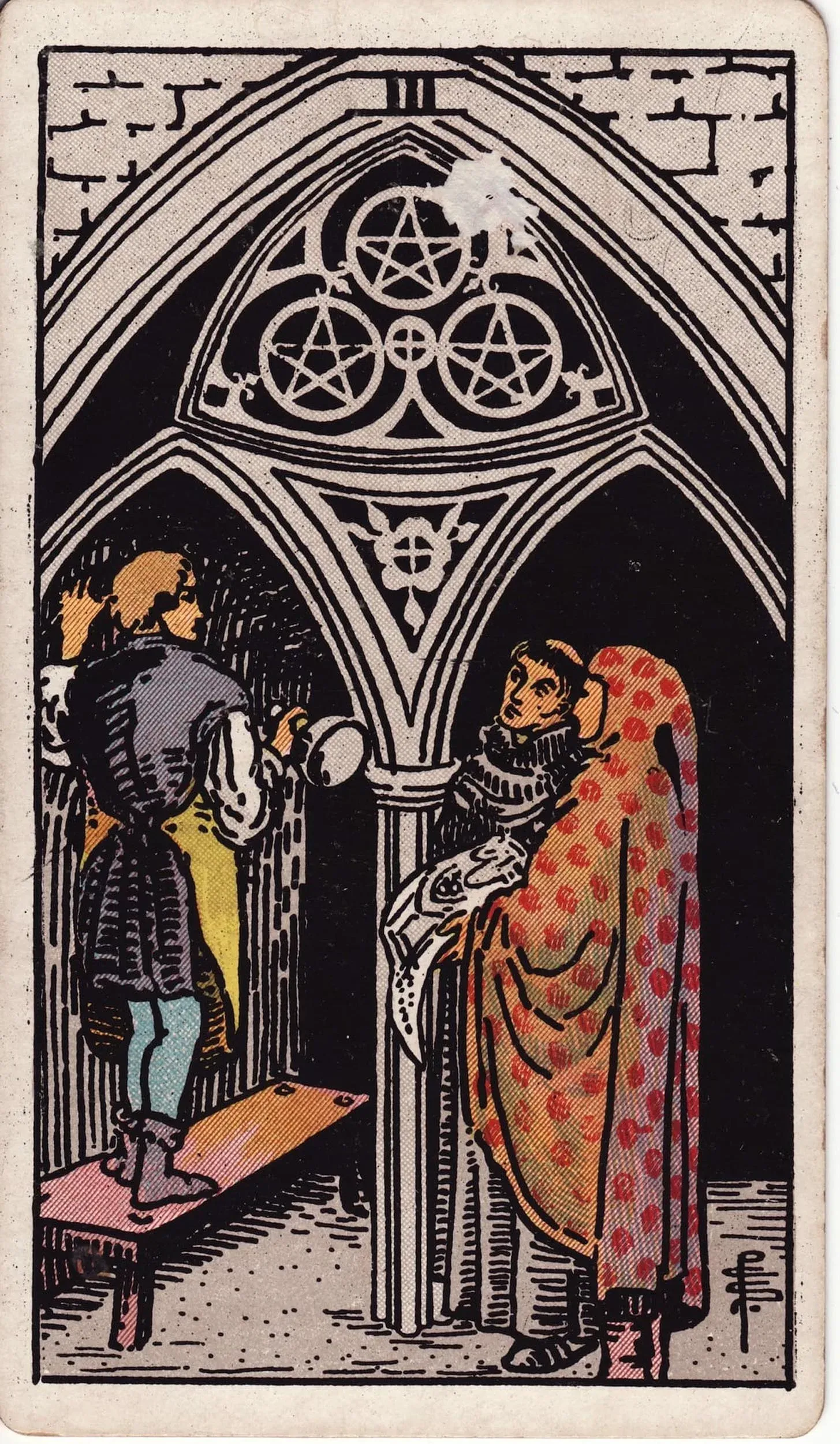
The Three of Pentacles shows a stonemason standing on a bench in a half-built cathedral, chisel in hand, while a monk and a man in fine clothes look at a plan. The work is skilled, the drawings are done, and the people who commissioned the building have turned up to watch it happen. The card names a job that needs more than one person, and the moment somebody notices you can do it.
What the Three of Pentacles says upright
Upright, this is teamwork with structure. There is a plan, a budget, and a division of labour, and the work goes well because each person is good at a different part of it. In a reading about a career it often means recognition: a qualification, or a project that finishes with your name on it. It also appears when you hire somebody, or when you finally ask for help from a person who knows the trade.
The card is honest about hierarchy. The mason is on a bench and the client is on the floor, and both of them are needed. Good collaboration here means clear roles and a straight account of what has actually been done.
What the Three of Pentacles says reversed
Reversed, the plan and the work do not match. Briefs are vague, nobody agrees who is doing what, and the person who did the difficult part goes uncredited. It can point to work handed in below standard, or to somebody on the team coasting on the group’s effort. Sometimes the card describes the opposite problem: you are trying to carry all of it alone and refusing help when it is offered. Either way the reading asks what the project actually needs, and who agreed to provide it.
Questions to ask in a reading
- Who is doing what here, and does everyone agree?
- Am I being paid for the skill I am actually using?
- Whose approval am I waiting for before I do the work properly?
- Which part of this have I not learned yet, and who could teach me?
How it reads with the other cards
With the Eight of Pentacles, the three turns solitary practice into work that somebody else depends on. The Ace of Pentacles is the offer that starts the contract. The Five of Wands shows the same group of people disagreeing about how the job should be done.