Card Meanings
What Does the Death Card Really Mean in Tarot Readings?
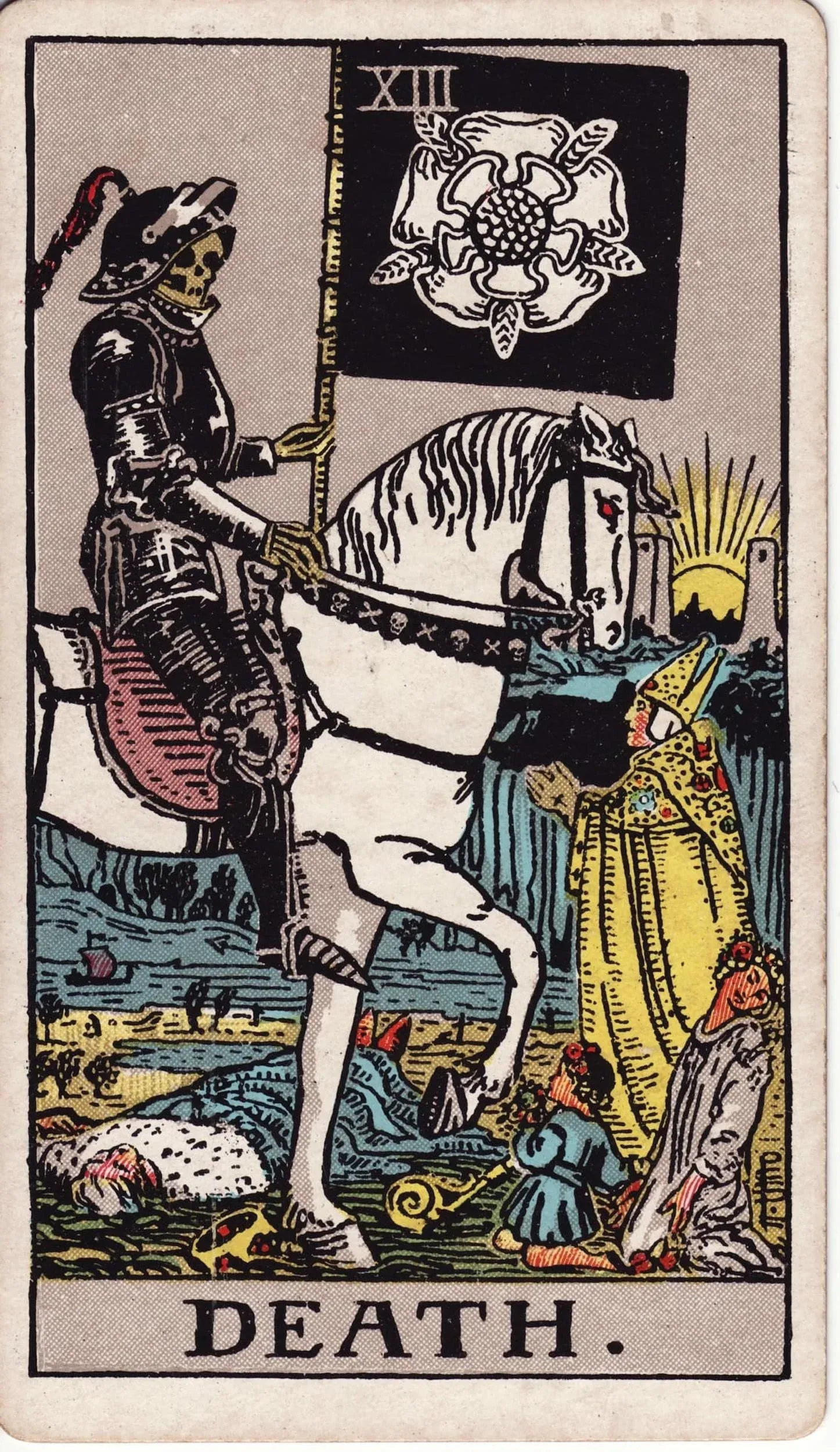
The Death card shows a skeleton in black armour riding a white horse, holding up a banner as it moves through a crowd. A king has fallen under the hooves, a bishop stands with his hands raised, and a child and a young woman wait at the side. Between two towers in the distance the sun is rising, which is the part people miss when they cannot look past the skeleton. It is the thirteenth card of the Major Arcana, and the one that makes people flinch. What it names is a situation that has run its course, and a space that has to be cleared before anything else can be built there.
What the Death card says upright
Upright, Death is the end of one phase and the beginning of the next. The skeleton is the one thing that comes for everybody, and its presence in a spread points at change that is happening whether or not you have agreed to it.
The rest of the picture argues for hope. The rising sun is rebirth, and the white rose on the banner has usually been read as purity, the idea that change clears and refines as much as it takes. The number XIII was never meant as bad luck: in numerological terms thirteen is upheaval and clearing, the point at which old habits break up to make room for something else. Death is also tied to Scorpio, which is where its reputation for depth comes from.
That is why the card rarely means what people fear. In a love reading it tends to show a relationship changing shape, through a deeper commitment or through letting go of something that has stopped working, and in a work reading it points at one role ending and another starting. Film and television lean hard on the grim version, and that is where most of the fear comes from.
What the Death card says reversed
Reversed, the card describes the same ending refused. You may be holding on to something that finished a while ago: a relationship that is over, a role you no longer have, a version of yourself you liked better. Staying where you are usually costs more than the change would, and frustration comes with it.
What it asks is that you let the transition happen. Naming what you are afraid of losing makes the next step easier to see, and letting go frees the energy you have spent on holding on.
Questions to ask in a reading
- What has already ended that I am still treating as open?
- What am I protecting by holding on to this?
- What would change if I stopped pretending the decision is not mine?
- What would I have to say goodbye to before something new could start?
How it reads with the other cards
The Tower beside Death describes a break that arrives all at once and was never asked for. The Sun is the other side of the same story, where the change leads somewhere brighter. The Lovers puts the ending inside a relationship, or inside a choice that has to be made before a person can move on.