
Tarot Basics
How to Read Tarot Cards: A Beginner's Guide
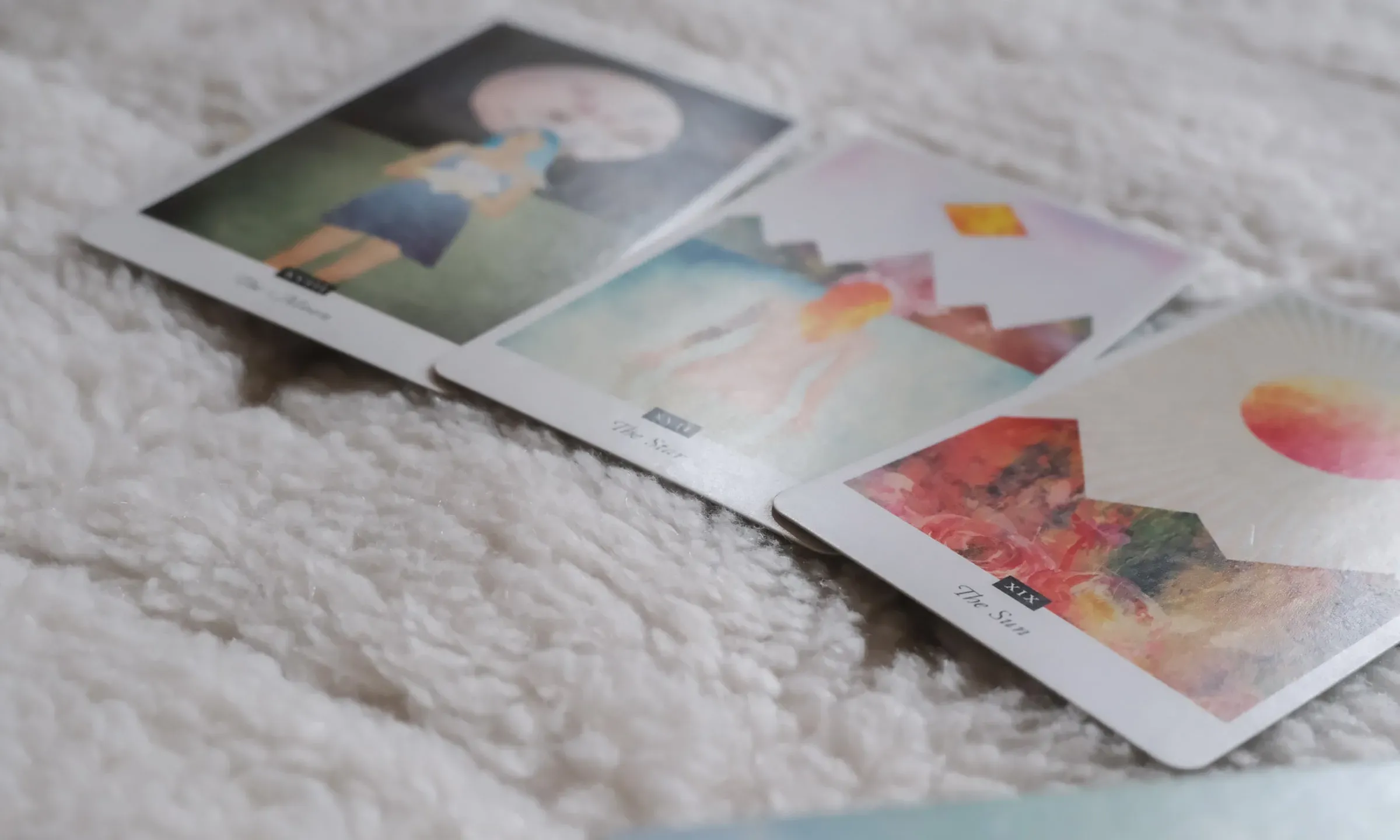
The basics of tarot card reading
Reading tarot is one way to look at a question from a different angle. The cards do not decide anything for you. They give you images and ideas to think with, and most of the work happens when you connect those ideas to what is actually going on in your life.
A tarot deck holds 78 cards. The 22 cards of the Major Arcana, from The Fool to The World, point at the larger themes: choices, endings, the things almost everyone runs into sooner or later. The other 56 cards, the Minor Arcana, deal with ordinary life. Its four suits cover work and effort, feelings and relationships, thought and conflict, and money and the body. When a Minor Arcana card turns up, it usually describes something close to the surface of your day.
Setting the scene
Find somewhere you will not be interrupted. Some people light a candle or put on quiet music. Others just close the door. Take a few slow breaths before you start and let your attention settle on the question you brought.
Shuffling the deck
Shuffling is part of the reading, because it is where your attention narrows and your question comes into focus. Shuffle however you like, overhand or on the table, and hold that question in mind while you do it.
Drawing the cards
When the deck feels ready, lay the cards out in whatever spread you have chosen and turn them over one at a time. Look at each image before you reach for a meaning. What is happening in the picture? Who is in it, what are they doing, where are they looking? Your first impression is often the most useful one.
Try a simple three-card tarot spread
A three-card spread is a clear place to begin. Ask one open question before you shuffle, something like “What should I understand about this decision?” Then lay three cards:
- Where I am now: the present energy, need or pattern.
- What to pay attention to: the influence, challenge or opportunity that deserves your focus.
- A helpful next step: a perspective or action to carry forward.
Write down what you notice before you look up card meanings, so you build a relationship with the cards instead of hunting for one fixed answer.
Interpreting the cards
A card’s meaning shifts with the question and with the cards around it. Start from the image and the traditional meaning, then ask how it fits the situation you asked about. Your own reaction counts too. If a card makes you uneasy in a reading about your work, that reaction is worth sitting with.
If you want a structured way to learn the deck, start with the Major Arcana and then work through one suit at a time.
Practice and patience
You will not learn 78 cards in a week, and you do not need to. Read for yourself often, note what you drew and what came of it, and let your understanding grow from those notes. Meanings that once felt arbitrary start to make sense once you have seen them play out in your own readings.
Choose a question you can work with
The shape of your question matters more than the size of your spread. “Will everything be all right?” is understandable, but it leaves the cards very little to hold. Try asking, “What am I missing about this decision?” or “What can I do this week to make this conversation easier?” A useful question has a situation, a point of view and some room for you to act.
If you are reading about another person, keep the question anchored in what you can observe and choose. “What does my partner secretly think?” asks the deck to replace a conversation. “What am I noticing in this relationship, and what should I ask about?” gives you a clearer next step. Tarot can help you frame a difficult talk; it cannot verify a private feeling for you.
Before you shuffle, write your question down. When you return to the reading later, you may discover that a card seemed confusing only because you quietly changed the question halfway through.
What to do when you do not know a card
Describe the image in ordinary language. Is the figure moving or still? Are they alone? What are they holding, and where does your eye go first? Write down one sentence about the scene before you consult a guide. You are not trying to invent a traditional meaning. You are giving yourself something concrete to compare with it.
Next, find the card in the 78-card meaning library. Read the upright meaning and the reversed meaning even if you only use upright cards in your deck. They often describe two ways the same theme can move: freely or with friction. Then return to the question and ask which detail actually fits. A card about money can speak to time or attention if those are the scarce resources in your situation.
Do not force a meaning because a book says it is the standard one. If the description seems remote from your life, set it aside and look at the other cards. A spread is a conversation between images, not three separate dictionary entries.
Reading a three-card spread, step by step
Suppose you ask, “How can I handle a project that is taking more time than I expected?” You draw the Two of Pentacles for where you are, the Nine of Wands for what needs attention, and the Ace of Swords for a helpful next step. You could read the first card as juggling commitments, the second as the cost of constant defence, and the third as a need to define priorities plainly.
That is not a prediction that the project will succeed or fail. It gives you a sequence to test: list the commitments, notice where you are tired, and have a clear conversation about the work. If the cards had appeared in a different order, the emphasis would change. Position matters, which is why it helps to decide what each place means before you turn the cards over.
Try saying the whole reading in two or three sentences. If you need a long story to make the cards fit, you may be adding more than the spread can support. Keep the interpretation close to the question and end with an action you can recognise in the coming week.
Should you read reversed cards?
A reversed card is one that lands upside down. Some readers use reversals; others turn every card upright. Both approaches can work. For a beginner, it is reasonable to start without them and learn the images first. If you do include reversals, avoid translating every card into its opposite. A reversed card might show a theme blocked, delayed, held inward or expressed too strongly.
For example, the upright Nine of Wands can show persistence after a hard stretch. Reversed, it might ask whether persistence has turned into exhaustion. The question and the neighbouring cards help you choose between possible readings. If the reversal adds nothing useful, do not force it into a warning.
Keep a small reading journal
After each reading, record the date, the question, the cards and two sentences about your interpretation. A week later, look back. Which part was useful? Which part was a guess you could not check? This is how you learn what a card means in your own practice without treating every coincidence as proof that the deck predicted the future.
You can keep the journal simple. A note on your phone is enough. Over time you may notice that a card appears around a particular kind of decision or that your first reaction to an image changes when you are stressed. That information is more valuable than memorising 78 definitions in one sitting.
If you want help connecting the cards in a personal question, see how an online reading with me works. The reading begins with your situation, and we look at the spread together.